
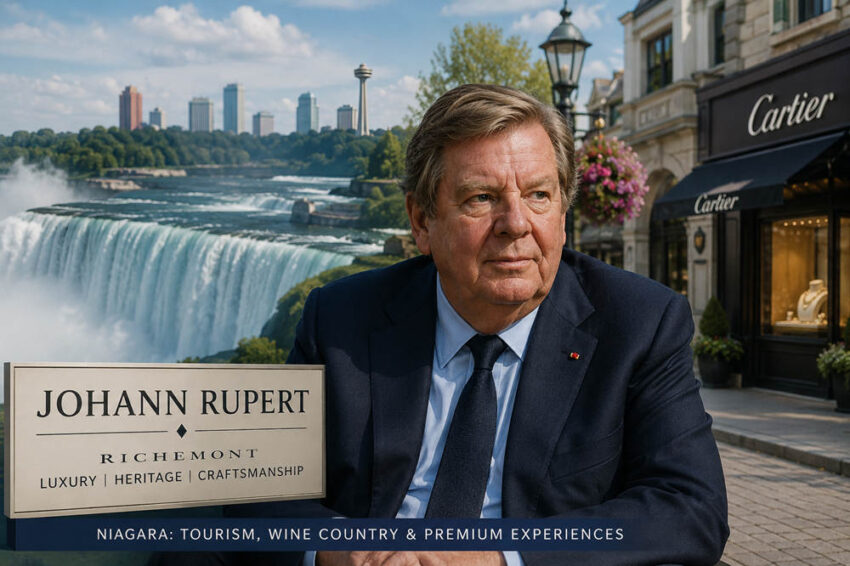
Johann Rupert is one of the most influential names in global luxury, so it is natural to wonder whether his business world has reached Niagara. The region welcomes millions of visitors each year, draws international attention through Niagara Falls, and has a growing reputation for wine, hospitality, dining, weddings, shopping, and weekend travel.
But the answer appears straightforward: there is no clear public evidence that Rupert, or the Richemont luxury group he chairs, has expanded directly into Niagara through a boutique, winery, hotel, real estate project, or major local investment. The more useful story is what this question reveals about Niagara’s place in the wider luxury, tourism, and retail economy.
Who Is Johann Rupert?
Johann Rupert is a South African businessman and the chairman of Richemont, the Swiss-based luxury group behind some of the world’s best-known jewellery, watch, fashion, and accessory houses. Richemont’s official profile notes that Rupert first joined the company’s board in 1988 and returned as chairman in 2014 after a sabbatical.
The company’s portfolio includes major maisons such as Cartier, Van Cleef & Arpels, Piaget, Vacheron Constantin, IWC Schaffhausen, Jaeger-LeCoultre, Montblanc, Chloé, and others. Richemont describes its maisons as brands known for heritage, craftsmanship, creativity, and memorable customer experiences.
That makes Rupert’s name relevant to conversations about luxury shopping and premium travel. Still, a global luxury reputation is not the same as a confirmed Niagara business connection.
What Would a Niagara Expansion Actually Mean?
A true Niagara expansion would need to involve something specific and documented. That could mean a Cartier boutique in Niagara Falls, a Van Cleef & Arpels location in Niagara-on-the-Lake, a Montblanc storefront, a Richemont-backed hospitality project, or a Rupert-linked wine or real estate investment in the region.
It could also mean an official company announcement, a store locator entry, a development record, or a reliable local report connecting Rupert or one of Richemont’s maisons directly to Niagara.
That distinction matters because Niagara already has plenty of premium experiences. Visitors can book upscale hotel rooms, enjoy winery lunches, plan spa weekends, attend theatre, dine at polished restaurants, or shop at well-known brand outlets. Those experiences help define Niagara’s visitor economy, but they do not prove that a specific global luxury group has expanded here.
Has Johann Rupert Expanded His Business Directly Into Niagara?
Based on available public information, the answer appears to be no.
There is no clearly listed Richemont-owned boutique in Niagara, no obvious Rupert-linked winery in the region, and no well-documented local hotel, retail, or real estate project tied to him personally. That does not mean Niagara shoppers cannot access Richemont products through online channels, private-client services, resale markets, travel shopping, or Toronto-area boutiques. It simply means there is no visible, public-facing Niagara expansion to point to.
The strongest Ontario evidence points elsewhere: Toronto.
Where Richemont’s Ontario Presence Appears Instead
Cartier’s official Canadian store information lists two Toronto locations: one on Bloor Street West and one at Yorkdale Shopping Centre. Van Cleef & Arpels also lists a Toronto boutique on Bloor Street West, placing both maisons in one of Canada’s most established luxury retail areas.
That pattern makes sense. Luxury houses often choose locations with a strong mix of affluent local shoppers, international visitors, luxury hotels, high-end restaurants, private-client traffic, and neighbouring premium retailers. Toronto’s Bloor-Yorkville area and Yorkdale fit that model more naturally than Niagara’s main shopping districts.
Niagara has enormous tourism value, but it is a different kind of market. Its shopping identity is shaped more by visitor convenience, outlet centres, gifts, food, attractions, duty-free shopping, and destination experiences than by a dense concentration of high-jewellery and watch boutiques.
Why Niagara Is Not the Obvious Richemont Fit
Niagara’s shopping scene is active, popular, and useful for visitors, but it is not mainly built around ultra-luxury jewellery and watch retail. Niagara Falls Tourism’s shopping guide highlights a mix of outlet shopping, gift shops, marketplace stops, duty-free shopping, chocolate shops, attraction retail, and visitor-friendly stores.
Outlet Collection at Niagara positions itself around brand-name fashion and lifestyle retailers, while Canada One Outlets promotes familiar brands, discounts, and tourist-friendly shopping. These destinations fit Niagara well because they serve families, day-trippers, cross-border shoppers, hotel guests, and people adding shopping to a broader Niagara itinerary.
A Richemont maison works differently. A Cartier or Van Cleef & Arpels boutique is not just a store; it is part showroom, part service environment, part brand statement, and part private-client space. The location has to support the image of the brand as much as the sale itself.
That is why Toronto is the more natural Ontario fit. Niagara brings millions of people into the region, but much of that spending is tied to hotels, restaurants, attractions, casinos, wineries, souvenirs, entertainment, and outlet shopping rather than concentrated high-jewellery retail.
Niagara Still Has a Premium Market
None of this means Niagara lacks premium appeal. In fact, the region has several qualities that luxury and hospitality companies care about: international visitors, romantic travel, destination weddings, wine tourism, casino traffic, scenic hotels, cross-border movement, and strong weekend demand from the Greater Toronto Area and Western New York.
Niagara-on-the-Lake especially has a polished travel identity built around wineries, historic streetscapes, restaurants, inns, theatre, seasonal events, and relaxed weekend escapes. The broader Niagara Peninsula is also Canada’s largest and most concentrated winemaking region, giving the area a premium identity that is not dependent on luxury storefronts.
That is the important difference. Niagara may not look like a traditional Richemont retail market, but it does have the ingredients for high-value travel. Its strongest luxury lane may be hospitality, wine, culinary tourism, boutique accommodations, private tours, spa experiences, and special-event travel rather than permanent high-jewellery boutiques.
Rupert’s Wine Background Adds Context
Rupert’s wine background does not create a Niagara business connection, but it does make the comparison with Niagara’s wine-country economy more natural. The Rupert family has well-known wine interests in South Africa, including L’Ormarins and the Rupert & Rothschild partnership.
Wine regions increasingly compete through more than bottles. They build a sense of place through vineyard views, tasting rooms, restaurants, architecture, events, lodging, design, and storytelling. Niagara understands that language well.
The region’s best wine-country experiences are about the full visit: the view from the patio, the quality of the tasting, the meal, the nearby inn, the drive through vineyard roads, and the memory guests take home. In that sense, Niagara already participates in a global conversation about how wine, travel, hospitality, and place work together.
That is where the Rupert comparison becomes useful. His business world is built around heritage, craft, service, brand identity, and experience. Niagara’s strongest tourism operators often work with similar ideas, even if the scale and price point are different.
What Kind of Luxury Expansion Could Fit Niagara?
If a Richemont-style company ever looked seriously at Niagara, the most natural opportunity might not be a standard boutique. A seasonal luxury event, private-client presentation, hotel partnership, winery collaboration, or curated travel experience could fit the region better than a permanent jewellery storefront.
Niagara is a place where people come to celebrate. Anniversaries, proposals, weddings, wine weekends, milestone birthdays, theatre trips, and romantic getaways are all part of the local travel economy. Those occasions can support premium spending, but in a different way than a downtown luxury shopping district does.
For now, that remains a hypothetical possibility. The evidence available today points to Toronto as the visible Ontario home for Richemont’s most recognizable luxury boutiques, while Niagara’s premium identity continues to grow through travel, wine, food, hospitality, and memorable local experiences.
Conclusion
Johann Rupert has not, based on available public information, expanded his business directly into Niagara. Richemont’s most visible Ontario luxury retail presence appears to be in Toronto, while Niagara’s shopping identity remains more outlet-based, tourism-focused, and experience-driven.
Still, the question is useful because it clarifies Niagara’s role in the wider luxury and tourism economy. The region may not be a Richemont retail market today, but it already has many qualities that shape premium destination travel: scenery, wine country, hospitality, heritage, and memorable experiences. The real story is not that Rupert has arrived in Niagara. It is that Niagara has its own kind of value, built less around luxury storefronts and more around experiences people remember.