
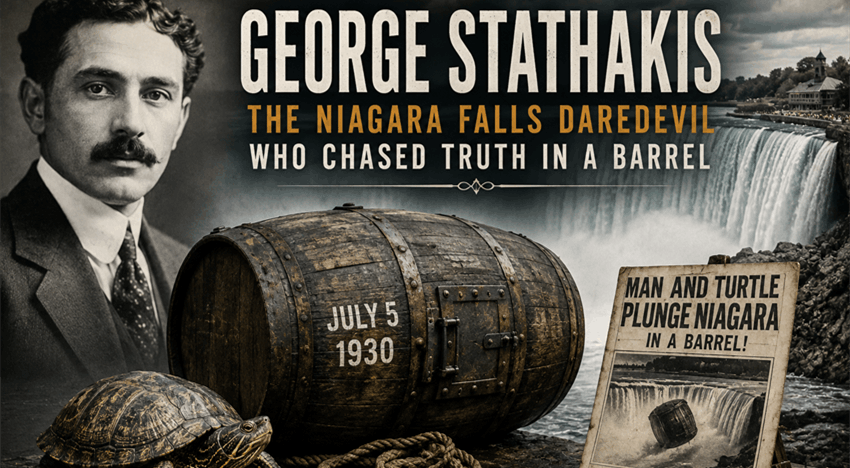
George Stathakis is one of the strangest and most tragic figures in Niagara Falls history. He was not simply a thrill-seeker chasing applause. He was a Greek immigrant, a short-order cook, a self-styled philosopher, a mystic, a writer, and a man who believed a plunge over Horseshoe Falls could somehow bring him closer to truth.
On July 5, 1930, Stathakis climbed into a massive wood-and-steel barrel with his pet turtle, Sonny Boy, and set out to conquer Niagara Falls. The barrel survived the drop. The turtle survived the ride. Stathakis did not.
His story still stands apart from other Niagara daredevil tales because it feels less like a stunt and more like a collision between ambition, belief, danger, and the overwhelming force of the Falls.
A Greek Immigrant With Bigger Dreams
George Stathakis was born in Greece and later came to the United States. Like many immigrants of his era, he worked ordinary jobs while carrying private dreams that were anything but ordinary. He lived in different American cities before settling in the Buffalo and Niagara area, where he worked as a cook.
But Stathakis did not see himself as only a cook. He saw himself as a thinker. He wrote about philosophy, spirituality, the mystery of human existence, and his own unusual ideas about time, identity, and truth.
To many people around him, he may have seemed eccentric. To himself, he was a man on a mission. He believed he had insights to share with the world, and he wanted the money and attention needed to publish his writings more widely.
Why Niagara Falls Drew Him In
Niagara Falls has always attracted more than tourists. It has drawn dreamers, performers, risk-takers, promoters, inventors, spiritual seekers, and people hoping to prove something to the world.
By the time Stathakis planned his stunt, Niagara already had a long daredevil tradition. Tightrope walkers, swimmers, barrel riders, and stunt performers had turned the Falls into a stage for human nerve and public spectacle. Some survived. Some did not.
For Stathakis, the Falls represented more than fame. He believed the experience could become part of his philosophical journey. The violence of the river, the fall into the gorge, and the time sealed inside the barrel were not just physical events to him. They were, in his mind, a kind of test.
He hoped the stunt would attract enough attention to help him publish another book. He also seemed to believe the experience itself would give him something meaningful to write about afterward.
The Barrel Built for Survival
Stathakis did not choose a light or simple barrel. His craft was huge, heavy, and built from wood and steel. It was roughly 10 feet long, more than five feet wide, and weighed close to a ton.
In theory, that strength was supposed to protect him. In practice, it may have helped seal his fate.
The barrel had a steel hatch secured with bolts and was designed to survive the brutal impact of the Horseshoe Falls. Inside, Stathakis had a mattress, an oxygen supply, and his pet turtle, Sonny Boy. The turtle was said to be more than 100 years old, and Stathakis treated him almost like a mystical companion.
That detail is one reason the story has lasted. A man going over Niagara Falls in a barrel is already dramatic. A man doing it with an elderly turtle he believed had special meaning is unforgettable.
The Day of the Plunge
On July 5, 1930, Stathakis entered the barrel and began his journey down the Niagara River toward Horseshoe Falls. Spectators and reporters watched as the barrel moved into the current.
The river carried him closer to the brink. Once the barrel reached the edge, it dropped over the Horseshoe Falls into the violent water below.
That part of the stunt worked. The barrel did not break apart. Stathakis had survived the fall itself.
But Niagara was not finished with him.
The Fatal Mistake
After the barrel went over the Falls, it did not quickly emerge where rescuers could reach it. Instead, it became trapped behind the curtain of water at the base of the Horseshoe Falls.
This was the disaster Stathakis had not fully planned for.
His barrel was strong enough to withstand the plunge, but he had only a limited oxygen supply inside. As the hours passed, rescuers could not get to him. The water held the barrel in place far longer than he could survive.
When the barrel finally came free and was recovered, Stathakis was dead. He had not been killed by the impact. He had suffocated while waiting to be rescued.
The tragedy was painfully simple: the barrel was too durable to break, too heavy to move easily, and trapped too long for the oxygen supply to save him.
Sonny Boy Survived
Then came the detail that turned the story into Niagara legend.
Sonny Boy, the turtle, was found alive.
The animal that Stathakis had taken with him into the barrel survived the plunge, the trapped hours, and the recovery. The contrast was startling. The man who believed the trip might reveal some deeper truth was gone, while the silent turtle lived on.
After the stunt, Sonny Boy became part of the public fascination around the story. People wanted to see the turtle, the barrel, and the remains of the failed adventure. The whole episode became part of Niagara’s daredevil mythology almost immediately.
Why the Story Still Feels Different
Many Niagara stunt stories are easy to understand. Someone wanted fame. Someone wanted money. Someone wanted to be first. Someone wanted to prove they were fearless.
George Stathakis is harder to place in that simple pattern.
Yes, he wanted attention. Yes, he hoped to earn money from lectures, publicity, and possibly film rights. But he also wrapped the stunt in his own spiritual and philosophical ideas. He was not only trying to beat the Falls. He seemed to believe the experience would give him a new kind of knowledge.
That makes his story more haunting. Stathakis was not just gambling with his body. He was gambling with his entire idea of himself.
The Niagara Daredevil Era
Stathakis belonged to a period when Niagara Falls was still seen by some people as a place where dangerous public stunts could create instant fame. The Falls had already made legends out of performers and survivors. Newspapers were eager for dramatic stories. Crowds gathered for spectacle. Promoters understood the power of a bold claim.
But the Falls were never a safe stage.
The Niagara River is not predictable in the way a theater or sports arena is predictable. Currents shift. Water pressure is immense. Rescue is difficult. Even carefully planned stunts can fail because the river does not care about human confidence.
Stathakis’s death made that reality clear. He had planned for the drop, but not for the long wait behind the water.
The Role of Red Hill Sr.
William “Red” Hill Sr. was one of the most famous Niagara river men of his time, and he was involved in recovering Stathakis’s barrel after the stunt. Hill knew the river better than almost anyone, and even with that knowledge, the situation was extremely difficult.
His presence in the story shows how dangerous Niagara rescue work could be. The problem was not only getting someone over the Falls. It was finding them afterward, reaching them, and doing it before time ran out.
In Stathakis’s case, time ran out long before the barrel could be opened.
A Cautionary Niagara Legend
Today, the George Stathakis story is not a guide to bravery. It is a warning.
Modern readers may look back at barrel stunts with curiosity, but it is important not to romanticize them too much. Niagara Falls is beautiful, but it is also deadly. The same water that draws millions of visitors each year has taken many lives.
Stathakis’s story shows how easily confidence can become miscalculation. He believed his barrel would protect him, and in one sense it did. It protected him from the impact. But it could not protect him from being trapped, from running out of air, or from the simple fact that Niagara is stronger than human design.
Why George Stathakis Still Matters
George Stathakis remains memorable because his story combines so many different pieces of Niagara history.
It is an immigrant story. It is a daredevil story. It is a local tourism story. It is a tragedy. It is also the story of a man who wanted to be seen as more than his daily job.
That last part may be the most human element of all. Stathakis wanted his ideas to matter. He wanted his writing to be read. He wanted the world to know his name. He chose a terrible and dangerous way to make that happen, but the desire underneath it is easy to understand.
People still talk about him nearly a century later, though probably not in the way he hoped.
The Turtle, the Barrel, and the Mystery
The survival of Sonny Boy gave the story a strange afterlife. The turtle became a symbol of the whole event: silent, mysterious, and almost unbelievable.
There is something darkly poetic about it. Stathakis had imagined that if he did not survive, Sonny Boy would carry the secret of the trip. Of course, the turtle could not explain anything. He could not tell the world what happened inside the barrel, what Stathakis felt, or whether the philosopher found any truth in his final hours.
That silence is part of why the story lingers. The most important witness could never speak.
Remembering George Stathakis Today
Niagara’s history is filled with grand hotels, honeymooners, inventors, soldiers, artists, performers, business owners, and tourists. But it is also filled with unusual figures like George Stathakis, people who stepped into the region’s story through bold, strange, and sometimes tragic choices.
His name belongs to the long list of Niagara daredevils, but it also sits apart. He was not the first to challenge the Falls and not the last to misunderstand their power. Yet the details of his life — the philosophy, the books, the heavy barrel, the old turtle, the failed rescue — make him one of the most distinctive characters in Niagara lore.
He came to the Falls looking for truth, attention, and a future beyond ordinary work. What he found was tragedy. What he left behind was one of the most unforgettable stories in the history of Niagara Falls.
Final Thoughts
George Stathakis’s story is easy to retell as a strange historical curiosity, but it deserves more than that. Behind the odd details was a real person with dreams, beliefs, and a deep need to be heard.
His 1930 plunge over Horseshoe Falls remains one of Niagara’s most haunting daredevil tales because it did not end with triumph at the base of the Falls. It ended in a sealed barrel, a failed rescue, and a turtle that lived to become part of the legend.
Niagara Falls has always inspired awe, romance, fear, and ambition. George Stathakis reminds us that the Falls can turn all of those feelings into history in a matter of minutes.