
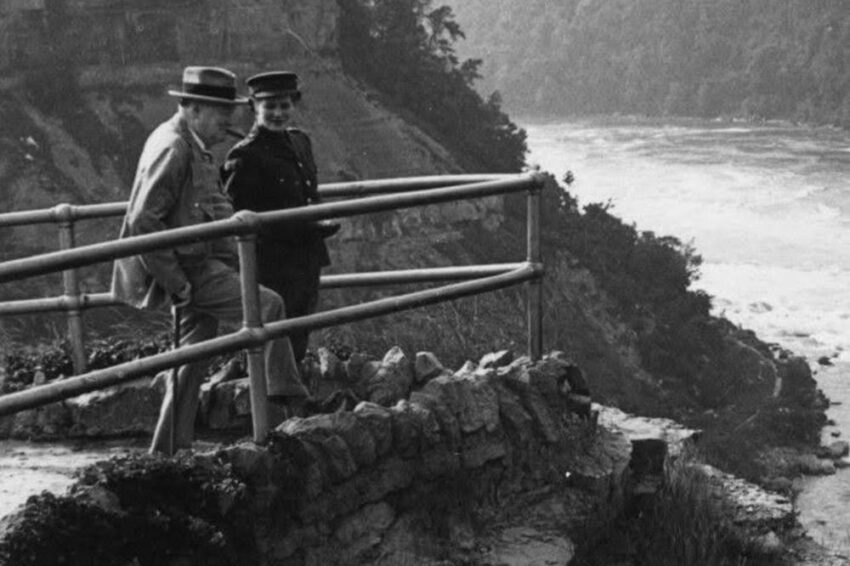
Winston Churchill’s Niagara connection comes from a short but memorable wartime visit. On August 12, 1943, Britain’s prime minister visited Niagara Falls with his daughter Mary while travelling through North America during the Second World War. The stop lasted only a few hours, but it linked Niagara to a larger story of wartime diplomacy, Canadian history, and one of the region’s most famous scenic routes.
Winston Churchill’s Connection to Niagara Falls
Churchill’s connection to Niagara is not a long local biography. He did not live in the region, build a political career here, or make Niagara Falls a recurring public destination. His local story is tied instead to one well-documented visit during one of the most demanding periods of the Second World War.
According to the Niagara Falls Public Library, Churchill visited Niagara Falls on August 12, 1943, with his daughter Mary. They were greeted by George Ingalls, the mayor of Niagara Falls, along with other dignitaries and officials. After arriving, they spent about half an hour viewing the Falls before continuing toward Queenston.
That brief itinerary is part of what makes the episode so interesting. Churchill was one of the central figures of the war, yet this Niagara stop also shows a quieter human moment: a father and daughter pausing beside one of Canada’s most powerful natural landmarks while history was moving quickly around them.
Why Churchill Was in Canada in 1943
Churchill’s Niagara visit happened just before the main meetings of the First Quebec Conference, also known by the code name Quadrant. The conference formed part of the Allied wartime discussions involving Churchill, U.S. President Franklin D. Roosevelt, and Canadian Prime Minister William Lyon Mackenzie King.
The First Quebec Conference was held in August 1943, with related meetings at Hyde Park and Washington surrounding the Quebec sessions. Its discussions helped shape major Allied strategy, including plans connected to campaigns in Italy and the future invasion of France.
For Churchill, travel through Canada at that time was not ordinary sightseeing. It was part of a demanding diplomatic and military schedule. Still, even the busiest wartime journeys could leave room for a short detour. Niagara Falls became one of those pauses, placed between high-level meetings and cross-border travel.
That timing gives the visit its unusual weight. Churchill did not come to Niagara for a long holiday, but he arrived at a moment when decisions being made in North America were tied to the future direction of the war.
What Happened During Churchill’s Niagara Visit
Churchill and Mary arrived in Niagara Falls on August 12, 1943. Local accounts describe a formal welcome, with Mayor George Ingalls and other officials present to greet the British prime minister. The visit included time at the Falls, where Churchill and Mary viewed the cataract before continuing along the Niagara River corridor.
The Imperial War Museums preserves a wartime image record of Churchill and Mary standing by Horseshoe Falls on that date. The photograph makes the visit feel immediate: Churchill in wartime, Mary beside him, and the Falls in the background as one of Canada’s most recognizable landscapes.
Horseshoe Falls would have offered the most dramatic view on the Canadian side. The scale, sound, and force of the water made it a natural stop for visiting leaders, royalty, performers, and public figures. Churchill joined a long list of famous visitors who came to Niagara not only to be received by local officials, but to stand near the edge of the Falls themselves.
After viewing the Falls, Churchill and Mary travelled toward Queenston to dine at the Queenston Heights Restaurant. Along the way, they stopped near Thompson’s Point, where a photograph was taken. The Niagara Falls Public Library notes that Churchill’s wife, Clementine, later used that image as a Christmas card, adding a personal family detail to an otherwise public wartime visit.
The Famous Niagara Parkway Quote
Churchill is also widely associated with one of Niagara’s most repeated travel lines. The Niagara Parkway is often described as “the prettiest Sunday afternoon drive in the world,” a phrase commonly connected to Churchill’s 1943 visit and his drive along the river.
The Niagara Parkway follows the Niagara River through a corridor of lookouts, gardens, historic sites, river views, and quiet stretches that feel very different from the busiest parts of the Falls. Travelling north from Niagara Falls toward Queenston and Niagara-on-the-Lake, the route gradually shifts from spectacle to scenery.
For many visitors, the Parkway remains one of the best ways to understand Niagara beyond the Falls. It connects Horseshoe Falls with the gorge, the Whirlpool area, Queenston Heights, vineyards, heritage streets, and the calmer pace of Niagara-on-the-Lake.
Churchill, Queenston Heights, and Niagara’s War History
Churchill’s stop near Queenston added another layer to the visit. Queenston Heights is one of Niagara’s most important historic landscapes, closely tied to the War of 1812 and the Battle of Queenston Heights. The area is also known for Brock’s Monument, one of the most recognizable memorials along the Niagara River.
Queenston Heights National Historic Site marks a battlefield landscape where memory, military history, and geography meet. For a wartime leader passing through Niagara in 1943, the setting would have carried a different meaning than a simple scenic stop. It was a place shaped by earlier conflict, borderland history, and public commemoration.
What Visitors Can Still Experience Today
Churchill’s exact 1943 visit belongs to another era, but modern visitors can still follow the broad shape of his Niagara route. A good starting point is Horseshoe Falls, where the Canadian side offers the region’s most iconic view. Queen Victoria Park, Table Rock, and nearby walking areas give visitors several ways to experience the power of the Falls from close range.
From there, the Niagara Parkway remains one of the most rewarding drives in the region. Travelling north from the Falls, visitors can follow the river past viewpoints, gardens, the Whirlpool area, and historic stops. The drive is best treated slowly, with time to pull over, walk, and let the river shape the pace of the trip.
Queenston Heights Park is a natural stop for anyone interested in the Churchill connection. The park area, monuments, river views, and nearby historic landscape help connect the Falls experience with Niagara’s deeper past. It also works well as a pause between Niagara Falls and Niagara-on-the-Lake.
Continuing toward Niagara-on-the-Lake adds another side of the region. The road leads into wine country, heritage streets, theatres, restaurants, and lakefront scenery. In that sense, the Parkway still lives up to the spirit of the line associated with Churchill: it turns the drive itself into part of the destination.
As with any Niagara trip, visitors should confirm current hours, parking rules, seasonal access, attraction operations, restaurant details, and road conditions before making plans. Local details can change because of weather, events, construction, staffing, and seasonal schedules.
Conclusion
Winston Churchill’s Niagara visit was brief, but it left a lasting place in local memory. The story brings together several versions of Niagara at once: the natural force of the Falls, the scenic beauty of the Parkway, the historic weight of Queenston Heights, and the personal detail of a world leader pausing with his daughter between major events. For Today Magazine readers, it is a reminder that Niagara’s history is not only found in museums and monuments. Sometimes it is found in a remembered drive, a family photograph, and a famous line that still follows the river today.
Featured Image Source: facebook.com