
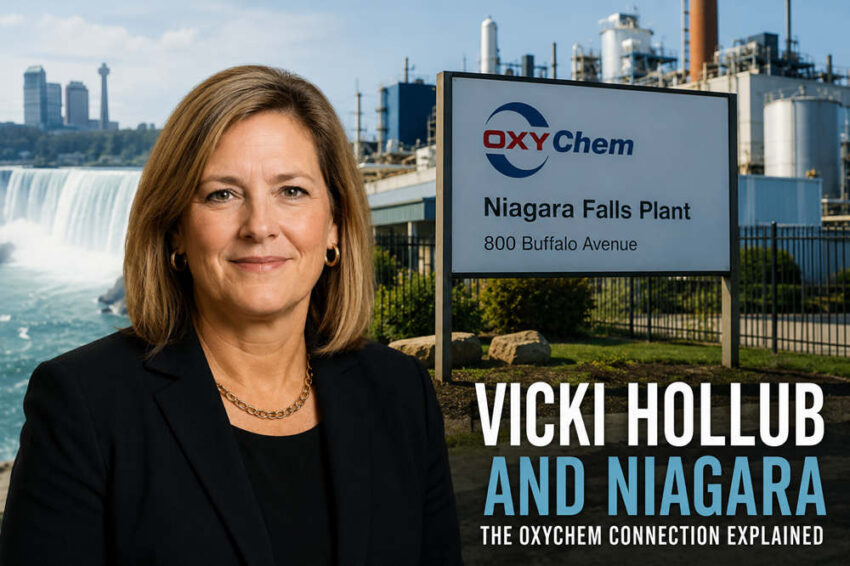
Vicki Hollub is not a Niagara figure in the usual hometown sense. Her name is not tied to the Falls through a famous visit, a local residence, or a personal public role in the region.
The connection is quieter and more corporate. Hollub led Occidental Petroleum during a period when the company was reshaping itself, and Occidental’s former chemical division, OxyChem, once operated a major manufacturing site on Buffalo Avenue in Niagara Falls. That site belonged to a long local story of industry, jobs, environmental responsibility, and change.
Now that Hollub’s time as Occidental’s chief executive has ended and OxyChem has been sold to Berkshire Hathaway, Niagara’s place in that corporate history is worth a closer look.
Who Is Vicki Hollub?
Vicki Hollub became president and chief executive officer of Occidental Petroleum in 2016 after spending decades with the company. Her rise made her one of the most visible women in the American energy industry, leading a major oil and gas company through a decade of acquisitions, debt reduction, portfolio changes, and growing attention to carbon-management projects.
In May 2026, Occidental announced that Hollub would retire as president and CEO effective June 1, 2026. Richard Jackson, then the company’s chief operating officer, was named as her successor, while Hollub remained on Occidental’s board.
Her biography is mostly a national energy-industry story. The Niagara chapter begins with the company name behind her tenure: Occidental.
How Occidental’s OxyChem Story Reaches Niagara Falls
Occidental’s local link runs through OxyChem, formerly known as Occidental Chemical. For many years, OxyChem was Occidental’s chemical division, producing materials used in water treatment, manufacturing, construction, industrial processing, and other essential sectors.
That changed in January 2026, when Occidental completed the sale of OxyChem to Berkshire Hathaway for $9.7 billion in cash. By then, the Niagara Falls manufacturing operation had already closed, but the sale added a clear ending point to Occidental’s OxyChem chapter.
In Niagara Falls, that history carries a different weight than it might in a corporate filing. The city has always had two identities running side by side: the world-famous destination built around the waterfalls, and the industrial city shaped by power, rail access, chemical plants, and generations of workers. OxyChem belonged to the second story.
The 2021 Plant Closure on Buffalo Avenue
The modern local turning point came in 2021, when OxyChem confirmed that it would close its manufacturing operations on Buffalo Avenue. According to WBFO’s local reporting, the company cited unfavorable regional market conditions and escalating rail transportation costs as the reasons for the shutdown.
The closure affected about 130 full-time employees and 20 contractors. In a city that has watched many industrial employers shrink, leave, or reinvent themselves, the announcement landed as more than another company update. It meant the loss of steady jobs, the end of a familiar operation, and another reminder that Niagara Falls’ manufacturing base was not what it once had been.
OxyChem said workers would receive support that included pay and benefits for a period, severance packages, outplacement services, counseling, and possible relocation help where available. Even with those measures, the shutdown marked the end of another piece of Niagara Falls’ industrial era.
The closure was not one of the defining national headlines of Hollub’s career. Still, it happened while she was leading Occidental, placing Niagara Falls within the larger story of how the company changed during her time at the top.
What the Niagara Falls Facility Made
The former OxyChem facility was part of the chlor-alkali industry, a basic but important area of chemical manufacturing. Chemical & Engineering News reported that the plant’s main products included chlorine, caustic soda, hydrochloric acid, and sodium hypochlorite.
Those materials may sound far from daily life, but they sit behind many ordinary systems. Chlorine is widely used in water treatment and industrial production. Caustic soda is used in paper, soaps, detergents, aluminum production, and chemical processing. Hydrochloric acid has many industrial uses, while sodium hypochlorite is closely associated with disinfection and bleaching.
That made the Niagara Falls plant more than a single local employer. It connected the city to a broader network of factories, utilities, sanitation systems, and industrial customers across and beyond Western New York.
The Hooker Chemical and Love Canal Background
Occidental’s Niagara history reaches further back than the OxyChem plant closure. In 1968, Occidental acquired Hooker Chemical, a company already deeply rooted in Niagara Falls’ chemical-manufacturing past.
That past includes Love Canal, the neighborhood that became one of the most widely known environmental disasters in the United States. Buried industrial waste, health fears, relocation, and years of cleanup turned Love Canal into a national symbol of what can happen when industrial growth leaves behind damage that communities must live with long after production ends.
Love Canal’s central history began long before Hollub became Occidental’s CEO. Her role belongs to a later period in the company’s life. But the Occidental name in Niagara Falls has never been only about business operations. It also brings up older questions about land, cleanup, accountability, and the long shadow of chemical manufacturing.
That is why the OxyChem story in Niagara cannot be told only as a plant-closure story. It sits inside a larger local memory, one shaped by both the jobs industry created and the responsibilities it left behind.
After the Shutdown: What Happens to an Industrial Site?
When a chemical plant closes, the change does not end with the final workday. Equipment has to be removed or secured. Buildings may need to be decommissioned. Land and environmental obligations can remain active for years.
After the Niagara Falls shutdown was announced, reporting noted that Glenn Springs Holdings, an affiliate connected to OxyChem, would oversee the property after decommissioning and continue managing other regional legacy properties. That detail matters because former industrial land often remains part of a city’s future long after the manufacturing stops.
Niagara Falls knows these questions well. Older industrial sites can become obstacles, opportunities, or both. Some may be cleaned up and reused. Others require long-term monitoring. Each one raises practical questions about jobs, redevelopment, environmental safety, public trust, and how much of the city’s industrial past can be turned into something useful again.
Why the Hollub Era Is a Natural Time to Revisit the Story
Hollub’s retirement as CEO and Occidental’s sale of OxyChem make this a natural moment to revisit Niagara’s place in the company’s history. One change ended a leadership era. The other moved Occidental’s longtime chemical business into Berkshire Hathaway.
For Occidental, the sale helped sharpen the company’s focus on its core energy business. For Niagara Falls, it underlined how far the local story had moved from active production to legacy management and memory. The Buffalo Avenue plant was already closed, and OxyChem was no longer part of Occidental’s future.
That shift says something larger about Niagara Falls itself. The city has moved through cycles of industrial growth, manufacturing decline, tourism development, cleanup work, and redevelopment hopes. The old chemical corridor is part of that story, just as surely as the parks and hotels are part of the city’s public image.
Hollub did not create Niagara’s industrial history. But her years leading Occidental overlapped with one of its more recent turning points: the final shutdown of OxyChem’s Niagara Falls manufacturing operation.
What the Niagara Connection Really Means
The Vicki Hollub-Niagara connection is not personal, but it is meaningful in a corporate and local-history sense. Through Occidental and OxyChem, her tenure intersects with a Niagara story about work, industry, environmental legacy, and economic transition.
The former Buffalo Avenue plant was part of the city’s manufacturing base. Its closure affected workers and marked another step away from the heavy industrial identity that shaped Niagara Falls for much of the 20th century.
The broader Occidental name also carries the older Hooker Chemical and Love Canal history. That history does not need exaggeration to matter. It is already part of Niagara’s complicated relationship with industry: the same forces that brought jobs and production also left behind cleanup responsibilities and public concerns that lasted for decades.