
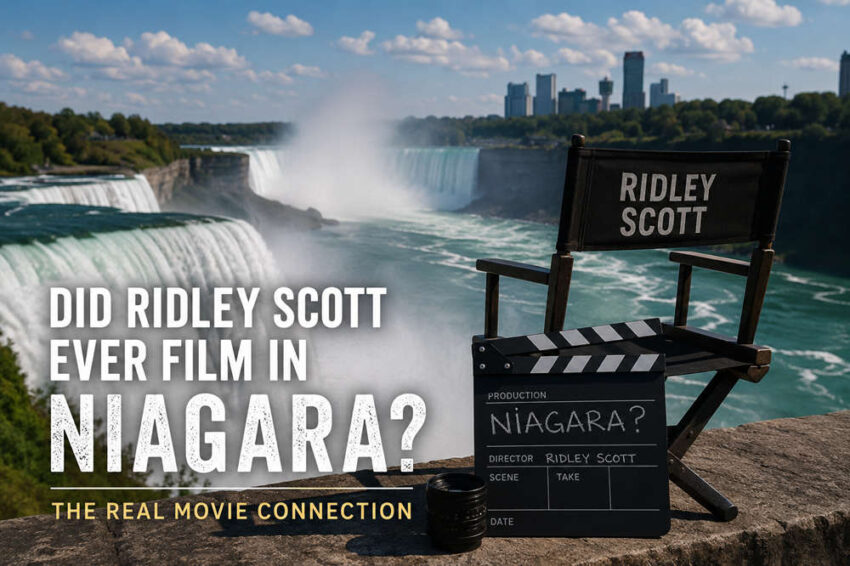
Ridley Scott and Niagara Falls sound like they should belong in the same conversation. Scott is known for bold, atmospheric filmmaking, while Niagara has the scale, mist, movement, and natural drama that directors love. Still, the real question is more specific: did Ridley Scott ever film a movie in Niagara?
Direct answer: no widely available film-location source shows that Ridley Scott directed a movie filmed at Niagara Falls or in the Niagara region. The connection appears to be a film-curiosity question rather than a confirmed production history.
Did Ridley Scott Ever Film a Movie in Niagara?
Available film-location guides, tourism film lists, and Ridley Scott location references do not show a confirmed Ridley Scott-directed movie filmed in Niagara. That does not mean every possible private production detail has been searched exhaustively, but it does mean there is no clear public basis for saying that Scott made a Niagara film.
That distinction matters. Ridley Scott is one of the most widely documented modern directors, with a career that includes films such as Alien, Blade Runner, Gladiator, Black Hawk Down, The Martian, and House of Gucci. A major Niagara shoot connected to a director of that profile would likely appear in location guides, production notes, local coverage, or official tourism material.
So the most accurate answer is simple: Ridley Scott does not appear to have a verified Niagara filming connection. The more interesting story is why the idea feels believable in the first place.
Why the Ridley Scott Niagara Question Makes Sense
Scott’s films are often remembered for their visual power. He has built worlds out of rain-soaked city streets, ancient battlefields, deserts, spaceships, imperial rooms, futuristic skylines, and harsh natural landscapes. His work often uses setting as more than background. The place itself helps create tension, mood, and scale.
Niagara has many of those same qualities. The Falls dominate almost any image of the region. Water moves with force. Mist rises into the air. Bridges, hotels, observation decks, tunnels, boats, lights, and crowds create a layered setting where nature and spectacle meet.
That is why “Ridley Scott Niagara” is not a random pairing, even if it is not a confirmed film credit. Niagara has the kind of visual presence that feels suited to large-scale cinema. It can look romantic in one scene, dangerous in another, and almost futuristic at night when the Falls are lit against the mist.
Niagara Falls Has Its Own Film History
Although the Ridley Scott connection does not appear to be confirmed, Niagara Falls has a real screen history. Destination Niagara USA’s movie list includes several productions associated with Niagara Falls, New York, including Niagara, Superman II, Canadian Bacon, Bruce Almighty, Pirates of the Caribbean: At World’s End, The Office, Tammy, Marshall, A Man Called Otto, and Cabrini.
These connections are not all the same. Some productions used the Falls as a major visual setting. Others used specific footage, local scenes, sound, or television-story connections. That variety is part of what makes Niagara interesting on screen: it can serve as a main location, a dramatic insert, a comic destination, or a recognizable cultural reference.
The 1953 thriller Niagara, starring Marilyn Monroe and Joseph Cotten, remains one of the most famous examples. The Falls are not simply scenery in that film. They help shape the mood: glamorous, tense, romantic, and dangerous. For many viewers, the movie helped define Niagara as a place where beauty and suspense could exist side by side.
Superman II used the Falls for a very different kind of screen moment, turning Niagara into a place of rescue and superhero spectacle. Bruce Almighty and The Office leaned into Niagara’s tourist identity, using familiar attractions and the idea of a memorable trip. Pirates of the Caribbean: At World’s End shows another kind of connection, using Niagara Falls footage for a larger fantasy-adventure effect.
What Makes Niagara So Cinematic?
Niagara works on camera because it offers instant scale. Even before a story begins, the setting tells viewers that something large is happening. The water, cliffs, mist, sound, and open views create a sense of force that is difficult to fake.
It is also a place of contrasts. The natural wonder sits beside hotels, restaurants, casinos, gift shops, streets, boat tours, viewing platforms, and border crossings. That mixture gives filmmakers many possible tones. A romance can use Niagara as a honeymoon setting. A thriller can use the mist, height, and water to create unease. A comedy can use the tourist energy. A documentary can focus on geology, power, tourism, conservation, or cross-border history.
The sound is part of the atmosphere too. The roar of the Falls can make a scene feel private, tense, or overwhelming. Mist can soften a shot or hide what is ahead. At night, the illuminated water changes the mood again, turning the landscape into something closer to a stage.
That range explains why people can imagine a Ridley Scott-style Niagara film. The location already has the drama, texture, and scale that visually ambitious directors often seek.
How Filming in Niagara Usually Works
For major productions, filming around Niagara Falls usually requires planning and approval. On the Canadian side, Niagara Parks manages commercial filming and photography on Niagara Parks Commission property. Its guidelines also cover requests involving filming, photography, recording, and drone use on Commission lands.
On the New York side, Niagara Falls State Park notes that the park has been used for feature films, reality television, music videos, documentaries, fashion shoots, and other productions, and that permits are required for commercial film or still-photography shoots.
This is one reason confirmed filming claims usually leave a trail. Productions may appear in permit information, local news coverage, tourism materials, studio notes, location-manager references, or film-location databases. When a famous director is involved, that trail is usually easier to find.
How to Check Niagara Filming Claims
Film-location confusion is common, especially with famous places. A viewer may remember a waterfall scene, a misty setting, a border-town atmosphere, or a dramatic landscape and assume it was Niagara. In other cases, a movie may use a quick shot, archival footage, a sound recording, or a setting reference rather than a full location shoot.
The safest way to check a claim is to compare several sources. Official tourism pages can confirm productions tied to a region. Film commissions and park agencies can explain filming requirements. Studio press materials may identify shooting locations. Local newspapers often report when large crews come to town. Established film-location guides can also help, especially when they match official or local reporting.
For Ridley Scott and Niagara, those kinds of public sources do not currently support a confirmed filming connection. But they do support a broader point: Niagara has long been a screen-friendly place, and its visual identity is strong enough to invite comparisons with directors known for cinematic scale.