
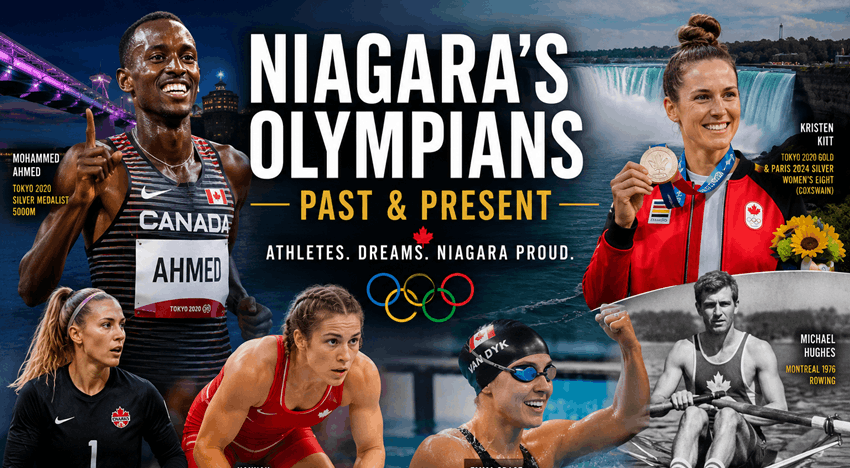
Niagara is known around the world for its waterfalls, wineries, history, and tourism. But the region has also built a quieter kind of legacy through sport. Across generations, athletes with Niagara roots have trained, competed, coached, and represented Canada at the Olympic and Paralympic Games.
Their stories stretch from rowing courses and running tracks to basketball courts, swimming pools, soccer fields, wrestling mats, cycling tracks, and international arenas. Some were born in Niagara. Some trained here. Some built their athletic identity through local clubs, schools, universities, and community programs. Together, they show that Niagara’s sports story is much bigger than one event or one era.
A Region With a Long Olympic Memory
The phrase “Niagara’s Olympians: Past and Present” captures more than a list of athletes. It points to a local tradition of recognizing the people who carried Niagara pride onto the world stage.
The Niagara Falls Public Library has even preserved that idea through its local history collections, including a display connected to Niagara Olympians past and present. That kind of local memory matters. Olympic stories can feel huge and far away, but they often begin in very local places: a pool, a rink, a school gym, a rowing club, a track, a community field, or a coach’s early encouragement.
For Niagara, the Olympic connection is not limited to one city. It reaches across Niagara Falls, St. Catharines, Welland, Port Colborne, Niagara-on-the-Lake, Lincoln, and the broader region. The names change from generation to generation, but the pattern remains: Niagara keeps producing and supporting athletes who reach elite levels.
Mohammed Ahmed and the Power of Distance
One of Niagara’s most recognizable modern Olympians is Mohammed Ahmed, the St. Catharines distance runner who became one of Canada’s greatest track athletes.
Ahmed’s Olympic story is historic. At Tokyo 2020, he won silver in the men’s 5,000 metres, becoming the first Canadian to win an Olympic medal in a long-distance track event. That achievement did not arrive out of nowhere. It came after years of consistent international racing, national records, difficult training, and close calls on the world stage.
For Niagara, Ahmed’s rise is especially meaningful because distance running is not always the loudest sport in the public eye. It does not have the spectacle of a packed arena or the constant attention of major professional leagues. It is built on patience, miles, discipline, and the ability to suffer quietly for a long-term goal.
Ahmed’s success gave Niagara a modern Olympic medal story rooted in endurance. His career reminds young athletes that greatness can come from steady work, not only from flash or early fame.
Kristen Kit and St. Catharines Rowing Tradition
St. Catharines has deep rowing roots, and Kristen Kit is one of the clearest examples of how that local rowing culture can lead to Olympic success.
Kit, a coxswain, helped guide Canada’s women’s eight to Olympic gold at Tokyo 2020 and silver at Paris 2024. The coxswain’s role is unique. It is not only about steering the boat. It is about rhythm, strategy, communication, trust, and reading the race in real time. A great coxswain has to be calm and commanding at once.
That makes Kit’s achievements especially impressive. She represents the kind of athlete whose contribution is easy to underestimate if someone only watches the surface of a race. But in rowing, the voice inside the boat can help turn strength into timing and effort into speed.
Her story also reflects St. Catharines’ place as one of Canada’s important rowing communities. Local water, clubs, coaches, and rowing tradition all help create the foundation for athletes to aim higher.
Sabrina D’Angelo and Welland’s Soccer Pride
Sabrina D’Angelo gives Welland a strong place in Canada’s Olympic soccer story. A goalkeeper with long national-team experience, D’Angelo was part of Canada’s bronze medal-winning women’s soccer team at Rio 2016 and returned to Olympic competition at Paris 2024.
Goalkeeping is one of the most mentally demanding positions in sport. A goalkeeper can be quiet for long stretches, then suddenly become the most important player on the field. The job requires patience, confidence, quick reactions, communication, and the ability to recover instantly from pressure.
D’Angelo’s path through youth national teams, NCAA soccer, professional clubs, and the senior Canadian team shows the long development road behind an Olympic roster spot. For young soccer players in Niagara, her career is a reminder that elite sport is rarely built in one leap. It is built through years of training, travel, competition, and resilience.
Hannah Taylor and Brock’s Wrestling Pipeline
Hannah Taylor may be from Prince Edward Island originally, but her connection to Niagara is strong through Brock University and Brock wrestling. Her Olympic debut at Paris 2024 added another major chapter to the region’s elite sports story.
Taylor competed in women’s freestyle wrestling and finished fifth in the 57-kilogram weight class at Paris 2024. That result placed her just outside the medals, but it also confirmed her position among the world’s best.
Her story shows how Niagara’s post-secondary sports programs can help attract, develop, and support high-performance athletes. Brock’s wrestling program has long been one of the strongest in Canada, and athletes who train there become part of the region’s sporting identity even if they were born elsewhere.
That matters. Olympic communities are not only defined by birthplaces. They are also defined by where athletes grow, train, study, compete, and find the people who help shape their careers.
Emma Van Dyk and Paralympic Representation
No modern look at Niagara’s international sports presence should leave out Paralympic athletes. Emma Grace Van Dyk of Port Colborne brought another important layer to the region’s story when she earned her place on Canada’s team for the Paris 2024 Paralympic Games.
Van Dyk, a para-swimmer with Brock Niagara Aquatics, secured her Paris spot after a record-setting performance in the S14 100-metre backstroke. Her story is powerful because it shows what sport can become when talent, therapy, persistence, coaching, and confidence meet over time.
Paralympic athletes often have to push through barriers that are physical, social, financial, and practical. Their achievements deserve the same regional pride as Olympic achievements. For Niagara, Van Dyk’s rise is not simply a nice local story. It is part of a broader reminder that excellence in sport takes many forms.
Past Names That Built the Path
Niagara’s Olympic story did not begin with recent Games. Earlier athletes helped create the path that today’s competitors continue to follow.
Gordon Singleton, from Niagara Falls, competed in track cycling at Montreal 1976 and was named to Canada’s team for Moscow 1980, though Canada joined the boycott of those Games. He later set world records and became one of Canada’s most notable cyclists of his era.
Mark Johnston of St. Catharines represented Canada in swimming at Sydney 2000 and Athens 2004. His long run with the national team and his connection to Swim Brock Niagara helped show how local swim programs could feed into international competition.
Greg Newton of Niagara Falls competed for Canada in men’s basketball at Sydney 2000. Nikki Johnson, also from Niagara Falls, represented Canada in women’s basketball at the same Games. Jay Triano, raised in Niagara Falls, became one of Canada’s most important basketball figures as both an Olympian and coach.
Niagara’s rowing history also includes names such as Michael Hughes, David Boyes, and Wendy Wiebe. Their Olympic appearances and medals helped connect St. Catharines and the wider region to one of Canada’s strongest summer Olympic sports.
These athletes matter because they give today’s Niagara competitors a history to inherit. Every new Olympian stands on a foundation built by others.
Why Niagara Produces Elite Athletes
There is no single reason Niagara has produced so many Olympic and Paralympic connections. It is not one magic facility or one coach. It is a mix of geography, community, tradition, and opportunity.
St. Catharines has rowing history and water access. Brock University gives the region a strong high-performance sports presence. Community clubs introduce young athletes to competition early. Local schools, coaches, volunteers, and families provide the support that often goes unnoticed until an athlete reaches the national stage.
Niagara also has a useful mix of small-city support and serious athletic opportunity. Athletes can grow up in communities where people know their names, while still accessing programs that push them toward provincial, national, and international levels.
That combination can be powerful. A young athlete needs more than talent. They need places to train, people who believe in them, and a pathway that makes big goals feel possible.
The Local Impact of Olympic Success
When a Niagara athlete reaches the Olympic or Paralympic Games, the achievement does not belong only to that athlete. Of course, the work is theirs. The sacrifice is theirs. The performance is theirs. But the pride spreads through the region.
A medal, a final, a personal best, or even an Olympic debut can inspire young athletes watching from home. It can make a child at a local pool, track, gym, rowing club, soccer field, or wrestling room think, “Maybe someone from here can do that.”
That belief is important. Representation is not only about seeing someone who looks like you. It is also about seeing someone from a place like yours. When Niagara athletes compete at the Games, they make the world stage feel a little closer to home.
Not Every Olympic Story Ends With a Medal
Medals are easy to celebrate, but they are not the only measure of Olympic achievement. Some Niagara-connected athletes have reached finals. Some placed just outside the podium. Some competed in team sports where their role was part of a larger collective effort. Some made it to the Games after years of injuries, setbacks, or financial pressure.
That is part of what makes Olympic stories so human. A fifth-place finish can represent the best performance of a lifetime. A single race can be the result of a decade of training. A substitute appearance, a heat, a qualifying round, or a roster spot can still represent a dream reached.
For a region like Niagara, the larger story is not only who won. It is who made it there, who kept going, and who showed the next generation what dedication looks like.
From Local Clubs to Global Stages
The Olympic and Paralympic Games are global events, but the road to them is usually local at first.
It starts when a parent signs a child up for a program. It starts when a coach notices potential. It starts when a teenager decides to keep training while friends move on. It starts when a local club creates a strong culture. It starts when a university program gives an athlete the next level of competition.
Niagara’s Olympians and Paralympians prove that international sport is not disconnected from community life. The world stage may be far away, but the first steps often happen close to home.
Keeping the Story Alive
Local sports history can disappear if communities do not protect it. That is why displays, library collections, sports halls of fame, newspaper archives, university stories, and community recognition matter.
Niagara’s Olympic past is not just a trivia list. It is part of the region’s identity. It shows that Niagara has contributed to Canada’s presence at the Games for decades, across many sports and many kinds of athletes.
Keeping those stories visible helps connect generations. A young rower can learn about past St. Catharines rowers. A swimmer can learn about Mark Johnston and Emma Van Dyk. A runner can look to Mohammed Ahmed. A soccer player from Welland can see Sabrina D’Angelo as proof that the path exists.
Final Thoughts
Niagara’s Olympians, past and present, tell a story of ambition, discipline, and local pride. They remind us that the region is more than a travel destination. It is also a place where athletes train, dream, struggle, improve, and sometimes reach the highest level in sport.
From historic names in rowing, basketball, cycling, and swimming to modern standouts in running, rowing, soccer, wrestling, and para-swimming, Niagara’s connection to the Games continues to grow.
The Olympics and Paralympics may happen on the world stage, but Niagara’s role begins much closer to home — in local clubs, school gyms, university programs, pools, tracks, boathouses, and families that believe a big dream is worth chasing.
That is the real legacy of Niagara’s Olympians. They do not only represent the region after they arrive at the Games. They represent it in every early morning practice, every local competition, every setback, and every moment when they choose to keep going.