
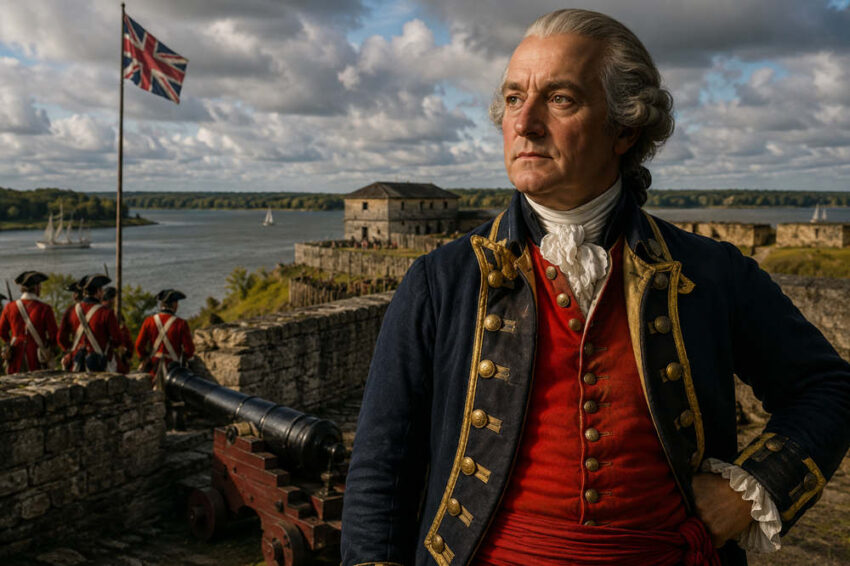
Behind the name Bill Johnson is a much older Niagara story: Sir William Johnson, Fort Niagara, and the struggle for influence along one of North America’s most important river corridors. Johnson was not a Niagara celebrity in the modern sense. He was an 18th-century British colonial official whose life intersected with the region at a time when the Niagara River carried military, diplomatic, and political weight far beyond its scenic beauty.
His connection to Niagara rests mainly on two major moments: the British capture of Fort Niagara in 1759 and the Treaty of Niagara in 1764. One was a wartime turning point. The other was a major treaty council involving the British Crown and Indigenous nations. Together, they show why Niagara’s history reaches far beyond the Falls themselves.
Who Was Sir William Johnson?
Sir William Johnson was born in Ireland around 1715 and moved to colonial New York as a young man. He built his influence in the Mohawk Valley, where he became a trader, landholder, militia officer, and one of Britain’s most important intermediaries with Haudenosaunee leaders.
Johnson later became superintendent of northern Indian affairs, a colonial office that placed him at the center of British diplomacy with Indigenous nations. He was known for working more closely with Indigenous diplomatic customs than many other British officials of his time. Councils, alliance language, gift-giving, kinship ties, and ceremony were all part of the political world he had to understand.
That influence made him useful to the British Crown, especially during the wars between Britain and France in North America. Still, his career should be read with care. Johnson’s wealth and authority were tied to colonial trade, land, office, and labor systems that included indentured servants and enslaved people. He was influential and historically significant, but he also worked inside a colonial order that placed growing pressure on Indigenous lands and sovereignty.
Why Fort Niagara Put Johnson at the Center of the Region’s History
Johnson’s Niagara story begins where the river meets Lake Ontario, at Fort Niagara. Today, Old Fort Niagara sits near Youngstown, New York, across the water from Niagara-on-the-Lake. Its location on the American side should not make the story feel separate from Niagara’s wider regional past. Before the modern border shaped how people imagine the area, the river corridor tied communities, armies, traders, and diplomats together.
The fort mattered because of geography. A post at the mouth of the Niagara River could influence movement between Lake Ontario and the upper Great Lakes. Before canals, railways, highways, and bridges changed travel, the river and the portage around Niagara Falls were essential to moving goods, supplies, canoes, soldiers, and messages between lower and upper waters.
For France and Britain, Fort Niagara was a prize because it opened the way inland. For Indigenous nations, the corridor was part of a much older landscape of travel, diplomacy, trade, and territorial responsibility. Johnson entered Niagara’s story because the region was already too important for competing powers to ignore.
The 1759 Siege of Fort Niagara
In 1759, during the French and Indian War, British forces moved against Fort Niagara as part of a wider campaign to weaken French power in North America. The fort was a major French military and supply post, linking Canada with the Ohio Valley and the western Great Lakes.
The British expedition was led by Brigadier General John Prideaux, with Sir William Johnson in a central supporting role. Johnson helped bring Indigenous allies, especially Haudenosaunee warriors, into the campaign. Their support mattered because military success in the region depended not only on soldiers and artillery, but also on alliances, local knowledge, and control of movement through the Niagara corridor.
The siege began in early July. British forces dug trenches toward the fort while artillery battered the French defenses. On July 20, Prideaux was accidentally killed by one of his own mortars. After his death, a council of war selected Johnson to assume command, a decision that helped preserve the support of Indigenous allies at a delicate point in the campaign.
The decisive battle came on July 24 at La Belle-Famille, near the Niagara portage route. A French relief force was moving toward the fort, hoping to break the siege. British regulars under Lieutenant Colonel Eyre Massey, along with Indigenous allies and colonial forces, defeated the relief column before it could reach Fort Niagara. Although Johnson received much of the public credit at the time, the victory depended on a wider group of commanders, soldiers, and Indigenous allies.
With relief no longer likely, the French commander negotiated surrender terms. British forces occupied Fort Niagara on July 25, 1759. The fall of the fort helped Britain gain control of Lake Ontario and weakened France’s ability to connect its remaining western posts.
For Niagara, this was a major shift. Fort Niagara did not simply change hands; the balance of power along the river changed with it. French influence gave way to British military control, and the region entered a new period of negotiation, uncertainty, and pressure.
What Fort Niagara Meant to the Region
Today, Fort Niagara can feel like a heritage site, a museum visit, or a scenic stop near Lake Ontario. In the 18th century, it was a strategic gate. Its position made it valuable to soldiers, traders, diplomats, and Indigenous nations with deep connections to the Great Lakes world.
Lake Ontario opened routes east toward the St. Lawrence River. The upper Great Lakes opened routes west and inland. Niagara Falls interrupted direct water travel, which made the portage route around the Falls essential. People and goods had to move overland before continuing by water.
That geography gave Fort Niagara its power. A fort at the river’s mouth could watch movement, support trade, guard supplies, and influence who passed between the lower and upper lakes. The site was not important because of one battle or one man. Its importance came from the land and water around it.
The Treaty of Niagara in 1764
Johnson’s second major Niagara connection came after the Seven Years’ War, when Britain had defeated France in Canada but still needed to define its relationships with Indigenous nations across the Great Lakes and beyond. Military victory did not automatically settle questions of land, trade, alliance, or authority.
In July and August 1764, Johnson met at Niagara with about 2,000 people representing roughly 24 First Nations. The gathering followed the Royal Proclamation of 1763, a British document that tried to organize Crown policy toward Indigenous nations and colonial expansion after France’s defeat.
The Treaty of Niagara was a major diplomatic council, not a simple signing ceremony. Johnson represented British interests, but the Indigenous nations who attended brought their own political traditions, expectations, and laws to the gathering. The council involved speeches, ceremony, exchanges, alliance language, and wampum.
That distinction matters. British officials often recorded agreements through written documents and imperial policy. Indigenous treaty diplomacy included spoken commitments, ceremonial obligations, and material records such as wampum belts. At Niagara, those different ways of making and remembering agreements met in one place.
Why Wampum Matters
Wampum is central to understanding the Treaty of Niagara. In many Indigenous diplomatic traditions, wampum belts carried memory, authority, and responsibility. They were used to mark commitments, renew relationships, and help communities remember what had been agreed.
At Niagara, wampum helped express the relationship between the British Crown and Indigenous nations. To look only at written colonial records would leave out much of the treaty’s meaning. The council was shaped by words, ceremony, exchange, and records that did not always fit neatly into British legal categories.
In Niagara, that widens the story beyond stone walls and battlefield dates. The region’s past is also about diplomacy, memory, law, and Indigenous political authority. Forts mattered, but so did councils. Military victories changed the map, but treaty relationships shaped what came next.
Johnson’s Complicated Legacy
Sir William Johnson’s legacy resists a simple label. He was more effective than many British officials at building relationships with Indigenous leaders. He understood that diplomacy required patience, ceremony, and respect for established protocols. Those skills gave him influence that few colonial officials could match.
At the same time, Johnson’s work served British imperial power. His diplomacy helped the Crown secure military alliances and political control after the defeat of France. His private interests were tied to land, commerce, and office. His household and business world also reflected the inequalities of colonial society.
That mix is what makes him important to Niagara history. Johnson’s career reveals the contradictions moving through the region in the 18th century: cooperation and coercion, diplomacy and expansion, alliance and dispossession. He should not be flattened into a hero or a villain. His story is more useful when it shows how power worked along the Niagara frontier.
What Remains in Niagara Today
Modern Niagara is often framed through waterfalls, wineries, theatre, parks, hotels, and weekend travel. That familiar image is real, but it sits above a much older landscape of forts, portage routes, Indigenous homelands, treaty councils, and imperial rivalry.
Fort Niagara remains one of the clearest places to see that older world. Across the river, Niagara-on-the-Lake and the Canadian side carry related layers of military, Loyalist, Indigenous, and colonial history. The water connects these stories, even when modern borders make them seem separate.
Johnson’s role in the 1759 siege links him to the military struggle for Fort Niagara. His role in the 1764 treaty council connects him to the diplomatic struggle over what British victory would mean for Indigenous nations and the Crown. Seen from the river, his story becomes part of a larger Niagara past: older, more complex, and more consequential than the postcard image of the region.