
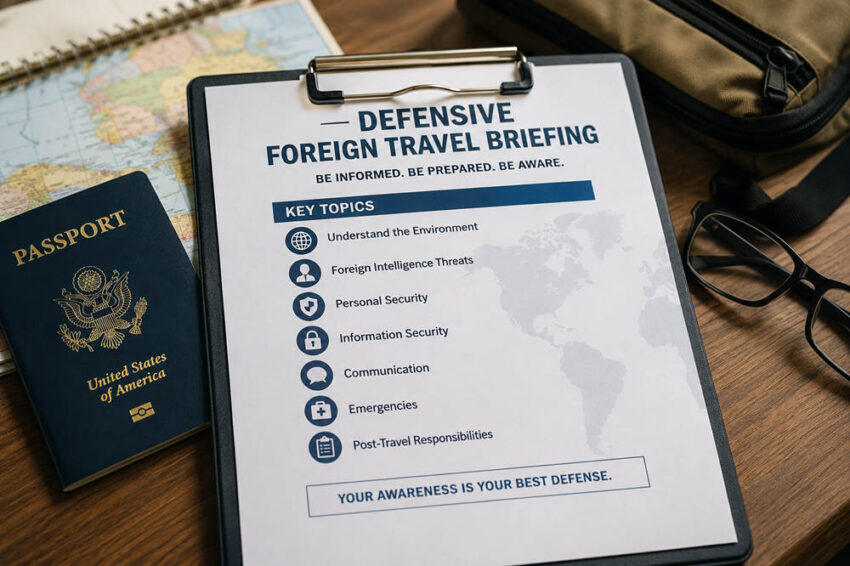
If you work in a cleared, military, federal, contractor, SCI, SAP, or other sensitive-position environment, you may need a defensive foreign travel briefing before traveling outside the country. Some organizations also require annual security or foreign-contact refresher briefings, but the exact rule depends on your agency, command, clearance level, contract, and security office.
For many security-awareness training questions, the expected answer is often phrased as before foreign travel and at least annually. In real workplace settings, however, the safest answer is more practical: complete the briefing when your organization requires it, and do it before the trip begins.
This is not a general rule for every tourist. Regular travelers who do not hold a clearance or sensitive position usually do not need a formal defensive foreign travel briefing. They can still prepare for international travel by checking official safety guidance and enrolling in the State Department’s Smart Traveler Enrollment Program.
What Is a Defensive Foreign Travel Briefing?
A defensive foreign travel briefing is a security-focused briefing designed to prepare covered travelers for risks they may face abroad. It is not a sightseeing guide, packing checklist, or ordinary travel-safety article. It is usually connected to counterintelligence awareness, classified-information protection, personal security, and foreign-travel reporting rules.
The briefing may cover foreign intelligence targeting, suspicious contacts, surveillance, electronic-device security, hotel and transportation risks, social media caution, local threat conditions, emergency contacts, and what to report after returning home.
The CDSE CI Foreign Travel Briefing describes the purpose of this kind of training as helping employees understand the risks associated with foreign intelligence operations before they depart on foreign travel.
How Often Is the Briefing Required?
The most useful answer is: before foreign travel, and as often as your organization requires.
In many cleared or government-related workplaces, annual security training may keep general awareness current. A trip-specific briefing may still be needed before travel, especially if the destination has higher security concerns, the traveler has SCI or SAP access, the trip involves official business, or the traveler’s role makes them a more likely target for foreign intelligence collection.
For personnel with Sensitive Compartmented Information access, DoD Manual 5105.21, Volume 3 says those planning official or unofficial foreign travel must report the anticipated travel and obtain a defensive travel security briefing or risk-of-capture briefing before travel.
That is why a simple “once a year” answer can be misleading. An annual refresher may satisfy one part of a security-awareness program, but it may not replace a required pre-travel briefing for a specific trip.
Who Usually Needs This Type of Briefing?
Defensive foreign travel briefings usually apply to people whose work or access creates a security responsibility. This may include military personnel, DoD employees, federal civilian employees in sensitive positions, cleared defense contractors, SCI-cleared personnel, SAP-access personnel, and employees working under contracts or programs with foreign-travel reporting rules.
For cleared industry, DCSA’s SEAD 3 unofficial foreign travel reporting guidance notes that companies under DoD cognizance should check with government customers for additional requirements involving SCI, SAP, or contract-specific obligations.
This is why two people may receive different instructions for similar trips. One traveler may only need to report the trip and complete a standard briefing. Another may need approval, a destination-specific counterintelligence briefing, device guidance, or a post-travel debrief.
Does It Apply to Personal Travel?
Yes, it can. For covered personnel, personal travel may still trigger reporting and briefing duties. The key issue is not whether the trip is for vacation or work. The key issue is whether the traveler’s clearance, access, position, destination, or planned activities create a security concern.
A cleared employee taking a family trip overseas may still need to report the travel before leaving. Someone with SCI access may have additional rules because DoD guidance covers both official and unofficial foreign travel. A contractor may also have to follow company procedures, contract requirements, and government-customer instructions.
Personal travel can feel private, but security responsibilities may still follow the traveler. That is why covered employees should check the required process before booking, changing, or departing on an international trip.
What the Briefing Usually Covers
A good defensive foreign travel briefing prepares travelers for realistic situations, not just worst-case scenarios. It may explain how foreign intelligence services collect information, how travelers may be approached socially or professionally, and why casual conversations abroad can become sensitive.
It may also cover device security, border inspections, hotel-room privacy, public Wi-Fi, transportation safety, local laws, crime risks, protests, medical emergencies, and emergency contact procedures. In higher-risk travel, the briefing may include destination-specific warnings and risk-of-capture information.
The practical goal is simple: help the traveler recognize risk early and avoid making easy mistakes. That can include limiting what they discuss in public, protecting work-related devices, avoiding unnecessary access to sensitive systems while abroad, and reporting unusual contacts or incidents after the trip.
Foreign Travel Reporting Is Not the Same as a Briefing
Foreign travel reporting and a defensive foreign travel briefing are closely related, but they are not the same thing.
Reporting is the administrative step. It tells the security office where the traveler is going, when they are going, why they are traveling, and how they can be reached. The briefing is the preparation step. It explains the risks and gives the traveler guidance before departure.
In some organizations, the process may include several steps: report the planned travel, receive any required approval or instructions, complete the briefing, follow security guidance while abroad, and report any required incidents or changes after returning.
What Happens After You Return?
Some travelers may also need a post-travel debrief. This may be routine in certain organizations, or it may be required when something unusual happens during the trip.
A debrief is especially important if the traveler experienced suspicious contact, questioning about sensitive work, detention, device loss, unusual searches, harassment, unexpected contact with foreign officials, or a major change from the approved itinerary.
The point is not to treat every trip as a problem. The purpose is to help the security office identify possible targeting, protect the traveler, and decide whether any follow-up is needed.
What Should Regular Travelers Do Instead?
Most ordinary travelers do not need a formal defensive foreign travel briefing. If you are traveling for vacation, family visits, study, or private business and do not hold a clearance or sensitive-position role, the government-style briefing requirement usually does not apply to you.
Still, the basic idea behind the briefing is useful for everyone: prepare before leaving. Regular travelers should check destination advisories, understand local laws, protect passports and phones, avoid oversharing travel plans online, and keep emergency contacts easy to access.
U.S. citizens and nationals traveling abroad can use STEP to receive safety and security updates from U.S. embassies and consulates. That is not the same as a defensive foreign travel briefing, but it is a practical tool for staying informed while overseas.
Why Skipping a Required Briefing Can Matter
If your organization requires a defensive foreign travel briefing, skipping it can create compliance and security problems. It may also raise questions about whether required foreign-travel procedures were followed.
This matters because foreign travel can create risks tied to foreign influence, foreign preference, personal conduct, technology exposure, and counterintelligence targeting. A briefing helps reduce those risks before they become problems.
The best approach is to avoid guessing. If you are covered by clearance, military, contractor, SCI, SAP, or agency rules, follow your organization’s process before you travel.