
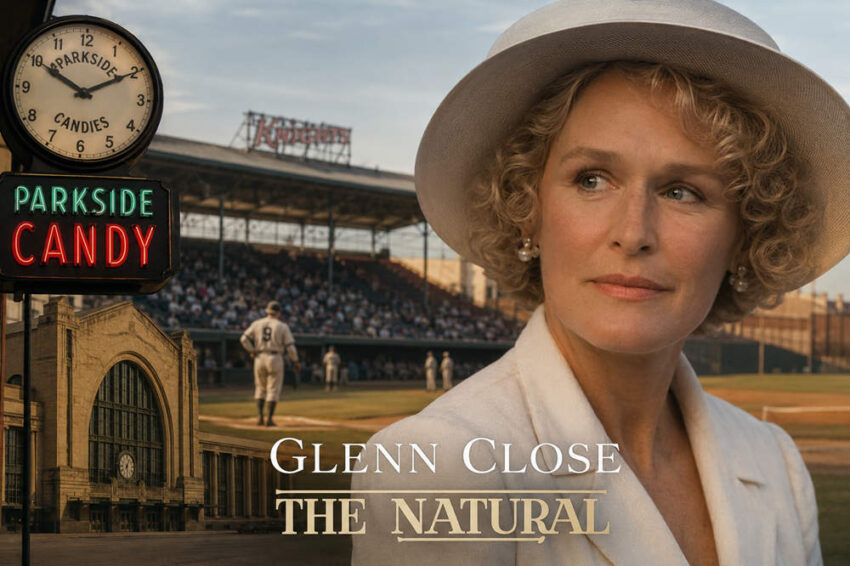
Glenn Close’s name is not tied to a major movie filmed at Niagara Falls, but it does connect to the wider Buffalo-Niagara screen world in a meaningful way. That connection comes through The Natural, the 1984 baseball drama that brought Close, Robert Redford, and a Hollywood production team to Western New York. For local film fans, the story is a reminder that some of the region’s most familiar streets, stadiums, and historic buildings have quietly helped shape classic movies.
Who Is Glenn Close?
Glenn Close is one of the most respected actors of her generation, with a career that has moved confidently between film, television, and theatre. She is known for performances that can be elegant, unsettling, funny, restrained, or emotionally direct, depending on the role.
Many viewers know her from Fatal Attraction, Dangerous Liaisons, 101 Dalmatians, Air Force One, The Wife, and the television drama Damages. Earlier in her film career, she appeared in The Natural as Iris Gaines, a woman from Roy Hobbs’ past whose return gives the story some of its emotional weight.
The role became part of Close’s long awards history. She received an Oscar nomination for The Natural, one of eight competitive Academy Award nominations across her career. In June 2026, the Academy of Motion Picture Arts and Sciences announced that Close would receive an Academy Honorary Award at the 2026 Governors Awards, giving film lovers another reason to revisit the performances that shaped her legacy.
Did Glenn Close Ever Film in Niagara Falls?
There is no strong public record of Glenn Close filming a major project specifically at Niagara Falls. The more accurate regional link is nearby Buffalo, where several scenes for The Natural were filmed.
That distinction keeps the story honest while still giving it a local angle. Niagara and Buffalo share a close cultural and travel corridor, and Western New York has often attracted productions looking for historic buildings, older streetscapes, industrial character, and distinctive architecture. In Close’s case, the connection is not a Falls location claim. It is a Western New York film-history story with easy relevance for readers across the region.
Glenn Close, The Natural, and Buffalo’s Movie Moment
Released in 1984, The Natural is a baseball drama directed by Barry Levinson and based on Bernard Malamud’s novel. Robert Redford stars as Roy Hobbs, a gifted ballplayer whose career is interrupted before he returns years later with almost mythic talent. Close plays Iris Gaines, a figure from Roy’s earlier life who reappears at a crucial point in the film.
The movie is remembered for its warm light, period costumes, old ballparks, and almost storybook view of baseball. Buffalo gave the film a convincing backdrop. Instead of relying only on studio sets, the production used real Western New York locations that already carried the mood of an earlier American city.
Close’s performance is quieter than some of the roles that later made her a pop-culture fixture, but that is part of its effect. Iris is remembered for stillness, tenderness, and the sense that she carries a history Roy cannot fully escape. In a movie filled with dramatic baseball imagery, her presence gives the story a more personal center.
The Western New York Locations Connected to The Natural
Part of the pleasure of revisiting The Natural from a local perspective is seeing how much of the film’s world was built from real Buffalo-area places. Some remain active or visible today. Others have changed, been repurposed, or disappeared, leaving behind only traces of their screen lives.
Parkside Candy
One of the most charming local connections is Parkside Candy on Main Street in Buffalo. The historic shop’s vintage interior fit the period mood of The Natural, and film-location accounts connect it to the scene involving Roy Hobbs and Iris Gaines.
For visitors, Parkside Candy offers something more interesting than a marker on a movie map. It is still a working local business, which means the film history sits naturally inside everyday Buffalo life. The appeal is not just that a famous movie used the space, but that the space still has the atmosphere that made it useful on screen.
War Memorial Stadium
Buffalo’s old War Memorial Stadium, often remembered as “The Rockpile,” played one of the film’s most important local roles. It stood in for the home ballpark of the fictional New York Knights, giving the movie a worn, lived-in sports setting that matched its 1930s-inspired world.
The original stadium was demolished after the Buffalo Bisons moved downtown, but the site did not vanish from local sports life. Today, the old location is home to the Johnnie B. Wiley Amateur Athletic Sports Pavilion. Visit Buffalo notes that preserved entrances from the former stadium remain, giving the site a direct physical link to its earlier life.
That makes the War Memorial Stadium story especially layered. It was once a real Buffalo sports landmark, then a fictional big-league ballpark in The Natural, and now a community athletic site with visible traces of the past.
All-High Stadium
All-High Stadium, associated with the Bennett High School athletic field in Buffalo, also appears in the film’s location history. It was used for scenes standing in for Chicago’s Wrigley Field, showing how the production turned Buffalo spaces into different parts of Roy Hobbs’ baseball world.
That kind of location work is easy to miss when watching the movie casually. A viewer may feel as if the story is moving from one city or ballpark to another, while Western New York is quietly supplying much of the visual texture.
Buffalo Central Terminal
Buffalo Central Terminal is another important part of the film’s regional backdrop. The former train station’s scale and Art Deco character made it a natural fit for a period story shaped by travel, memory, and return.
The terminal’s own story has continued long after its appearance in The Natural. The Central Terminal Restoration Corp., in partnership with the City of Buffalo, has selected development partners to advance reuse of the historic campus. That current work gives the location fresh relevance for anyone interested in how Western New York preserves and reimagines its landmark buildings.
Glenn Close’s Career Beyond The Natural
The Natural is only one chapter in Glenn Close’s career, but it remains an important early one. It came during a strong run of 1980s performances that helped establish her as a major screen actor after The World According to Garp and The Big Chill.
Her later work showed just how wide her range could be. In Fatal Attraction, she became part of one of the most discussed thrillers of the decade. In Dangerous Liaisons, she brought intelligence and control to a period drama built on manipulation. In 101 Dalmatians, she turned Cruella de Vil into a live-action spectacle. In The Wife, she delivered a quieter performance about recognition, sacrifice, and authorship.
Seen beside those roles, Iris Gaines is more understated. Still, the character stays with viewers because Close gives her emotional clarity without overplaying the part. That restraint is one reason The Natural remains worth revisiting, especially for readers who enjoy seeing how a major career intersects with nearby places.
Visiting the Region’s Film-History Spots Today
For anyone planning a Buffalo-Niagara film-history outing, The Natural offers several points of interest. Parkside Candy remains the most approachable stop because it is still an active business. Other locations require more context, especially where buildings have changed, access is limited, or the original site has been repurposed.
War Memorial Stadium, for example, no longer stands as it appeared in the film, but the Johnnie B. Wiley site keeps part of that history visible. Buffalo Central Terminal is undergoing a long process of restoration and redevelopment, so visitors should check current access and event details before making plans. The same practical caution applies to any historic or school-related site connected with filming.
The appeal of these places is not only nostalgia. They show how regional landmarks can hold several identities at once. A candy shop becomes a movie scene. A stadium becomes a fictional ballpark. A train terminal becomes a symbol of travel and memory. Across Western New York and Niagara, that layered sense of place is part of what makes local history so rewarding to explore.