
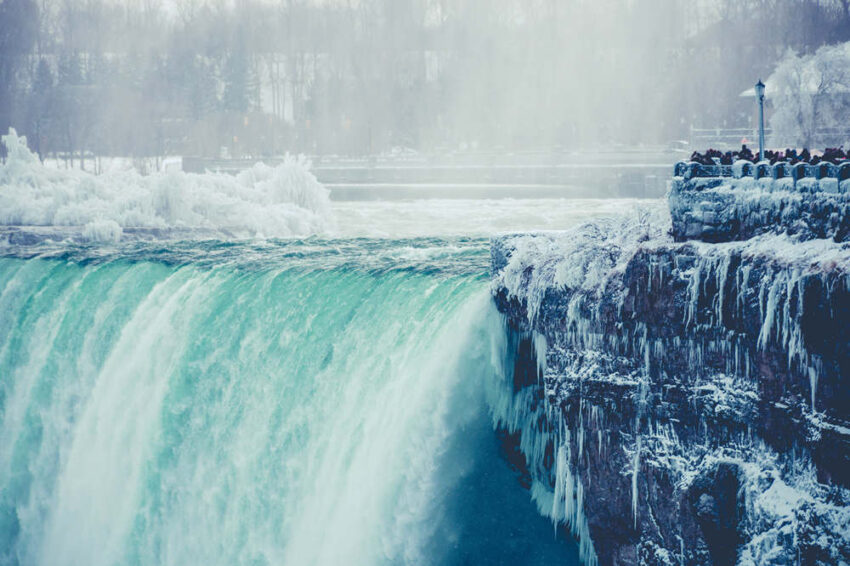
If you have ever seen icy winter photos and wondered, does Niagara Falls freeze, the answer is more interesting than a simple yes or no. Niagara Falls does not usually freeze solid, but in deep winter it can look as if it has. Mist turns to ice, snow settles across the gorge, and frozen spray coats nearby trees, rocks, railings, and lookout areas.
The water, however, keeps moving. That contrast is what makes Niagara Falls so striking in winter: a powerful waterfall surrounded by a landscape that can look almost completely frozen.
Niagara Falls Does Not Usually Freeze Solid
Niagara Falls is far too powerful to freeze like a pond or small stream. During peak daytime tourist hours, Niagara Parks notes that more than 168,000 cubic metres of water can go over the crestline every minute. That enormous flow helps explain why the Falls continue running even when the air is bitterly cold.
What visitors often see in winter is not a stopped waterfall, but ice forming around it. The edges, cliffs, gorge walls, and surfaces near the mist can become covered in white. From a distance, or in a carefully framed photo, that ice can make Niagara Falls look frozen in place.
So the clearest answer is this: Niagara Falls can appear frozen, but the main flow usually continues beneath and between the ice.
Why Niagara Falls Looks Frozen in Winter
The frozen look comes from the way cold air interacts with mist and spray. Niagara Falls creates mist year-round, but winter changes what happens to it. When temperatures drop below freezing, tiny water droplets can harden on contact with nearby surfaces.
That is why the winter scene can feel so dramatic. Trees may look glazed in white, rocks can disappear under rounded ice formations, and railings near the Falls may be wrapped in frozen spray. The water is still rushing, but the scenery around it becomes icy enough to create the famous frozen-falls effect.
Frozen Mist and Spray
Mist is one of the biggest reasons Niagara Falls looks so magical in winter. As the water crashes down, fine droplets rise into the air and drift across the gorge. In freezing weather, that moisture can cling to trees, cliffs, walkways, and viewing areas.
On very cold days, the mist may create rime ice, icicles, and thick white coatings across the landscape. This is the view many people have in mind when they talk about “frozen Niagara Falls.” The Falls themselves are not sealed in ice, but the surrounding area can look transformed.
Ice Along the Edges and River
Ice can also gather along the river, near the base of the Falls, and around parts of the rock face. Chunks of ice may move through the Niagara River and collect below the Falls, adding to the impression of a frozen scene.
The American Falls can sometimes appear more heavily iced than Horseshoe Falls because less water flows over that section. Horseshoe Falls usually shows more visible open water, even when the surrounding cliffs and mist-covered areas are coated in ice.
Has Niagara Falls Ever Stopped Flowing? The 1848 Ice Jam
Niagara Falls has stopped or nearly stopped in rare circumstances, but not because the waterfall simply froze solid. The best-known event happened in March 1848, when a massive ice jam formed near the source of the Niagara River at Lake Erie.
The blockage severely restricted the river’s flow, and the usual roar of the Falls became strangely quiet. According to the Library of Congress, the silence lasted through the day and into the next evening before the water broke through the ice dam and resumed its course.
This event is often described as the day Niagara Falls stopped flowing. It was real, but it was caused by an upstream ice jam, not by the Falls freezing from top to bottom.
What Was the Niagara Falls Ice Bridge?
The Niagara Falls ice bridge was a historic winter phenomenon that formed below the Falls when ice and slush collected in the lower river. In some winters, the mass became so large that it looked like a glacier. Niagara Parks notes that the ice bridge could build to an impressive height when conditions allowed.
In earlier eras, people treated the ice bridge like a seasonal attraction. Historic accounts and photographs show visitors walking on the frozen surface, and vendors once set up small huts there. Today, that belongs firmly in the past.
River ice near Niagara Falls is dangerous and unstable. Modern visitors should never walk onto ice in the Niagara River or near the base of the Falls. The safe way to enjoy the winter scenery is from official viewpoints, marked paths, and open attractions.
When Are You Most Likely to See the Frozen Falls Effect?
The frozen-falls effect is most likely in January and February, especially after several days of sustained cold. A single chilly day may create a few icy details, but the most dramatic scenes usually need freezing temperatures to last long enough for mist and spray to build up.
Even then, the view changes from year to year. Some winters bring long cold stretches and heavy ice formations. Others are milder, with only brief periods of snow and ice. Wind, sunlight, recent storms, and water conditions can all affect what visitors see.
In person, the winter scene is usually a mix of open rushing water, ice-covered rocks, frozen mist on trees and railings, snow along the gorge, and shifting clouds of spray. It can look different in the morning than it does later the same day.
Best Places to View Niagara Falls in Winter
Winter is a beautiful time to visit Niagara Falls, but it helps to choose safe, official viewing areas. The Falls can be viewed year-round, while individual attractions, restaurants, tunnels, decks, and seasonal experiences may follow changing schedules. Before making plans, check current hours and conditions with the relevant park, attraction, or tourism source.
Canadian Side Views
On the Canadian side, the Table Rock area near Horseshoe Falls is one of the classic winter viewpoints. It places visitors close to the brink, where the sound of the water, rising mist, and icy surroundings create a powerful cold-weather scene.
Journey Behind the Falls can also offer a memorable perspective when open, especially for visitors who want to experience the force of the water from a lower viewing area. Because winter access can change, it is smart to check Niagara Parks hours of operation before building a day around a specific attraction.
The Niagara Parks Power Station and Tunnel viewing area may also appeal to winter visitors when available. It pairs indoor heritage and engineering exhibits with a dramatic outdoor view, which can be helpful on especially cold days.
U.S. Side Views
On the New York side, Niagara Falls State Park offers winter views of the American Falls, Bridal Veil Falls, Goat Island, and the surrounding gorge. Prospect Point and other marked viewpoints can be especially striking when ice clings to the rock face.
The U.S. side is often rewarding for visitors who want to see the more ice-covered face of the Falls. The American Falls may appear more frozen than Horseshoe Falls in cold weather, making it a strong choice for winter photography.
As always, stay within open public areas and follow posted signs. Snow, ice, and mist can affect paths, stairs, and railings quickly in winter.
Is It Safe to Visit Niagara Falls in Winter?
Yes, Niagara Falls can be safe to visit in winter, but the conditions require extra care. Cold wind, freezing mist, slippery pavement, icy stairs, and sudden snow can make the area more challenging than it appears in photos.
Dress in warm layers and wear boots with good traction. Gloves, a hat, and a wind-resistant coat can make a big difference, especially near open viewpoints where mist and wind can make the temperature feel colder.
Most importantly, stay behind barriers. Do not climb onto ice, step over railings, or walk near the river’s edge. Ice around fast-moving water can break, shift, or hide dangerous gaps. The best winter views come from approved lookout areas, not risky shortcuts.
So, Does Niagara Falls Freeze?
Niagara Falls does not usually freeze solid. What freezes is the world around the rushing water: mist, spray, rocks, trees, railings, and parts of the river landscape. That is why the Falls can look frozen while still flowing with incredible force.
The famous 1848 stoppage was a rare ice-jam event upstream, not a normal winter freeze. Most visitors today are seeing the frozen-falls effect, where ice and snow frame the moving water in a way that feels almost unreal.
That is the real beauty of Niagara Falls in winter. It is not a silent wall of ice. It is a living waterfall surrounded by frozen mist, snowy cliffs, and one of the most memorable cold-weather views in the Niagara region.