
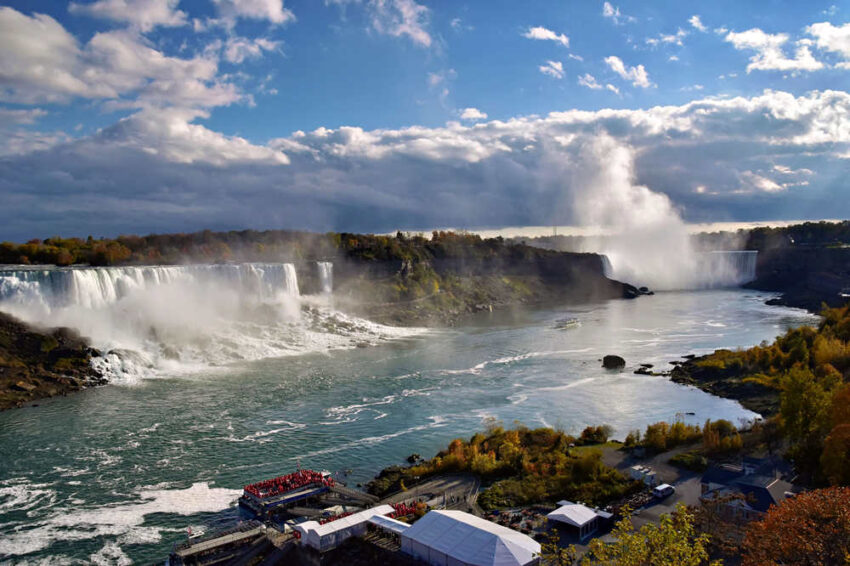
Niagara Falls is often called one of the world’s great natural wonders, and it is easy to understand why. The roaring water, rising mist, dramatic gorge, and international setting make it one of the most recognizable landscapes in North America. But is Niagara Falls officially one of the Wonders of the World? The answer depends on which list you mean.
Niagara Falls is not one of the original Seven Wonders of the Ancient World, and it is not one of the New Seven Wonders of the World. It is also not one of the elected New7Wonders of Nature. Still, in everyday travel language, calling Niagara Falls a natural wonder is completely fair.
Why People Think Niagara Falls Is a Wonder of the World
The confusion makes sense. Niagara Falls feels like the kind of place that should appear on a wonders list. It is huge, loud, beautiful, and instantly recognizable. For many visitors, the first view of Horseshoe Falls or the American Falls feels less like a scenic stop and more like a full natural spectacle.
The falls are also unusual because they sit along the border between Canada and the United States. Visitors can experience Niagara Falls from both Ontario and New York, with different views, parks, boat tours, observation areas, and walking paths on each side. That cross-border identity has helped make Niagara one of the most famous waterfall destinations in the world.
Another reason people connect Niagara Falls with the “wonders” idea is the language used around it. Tourism guides, parks, travel writers, and visitors often call it a “natural wonder.” That phrase is not the same as being officially named one of the Seven Wonders, but it has shaped how people talk about the destination.
Niagara Falls also has a long tourism history. For generations, it has drawn honeymooners, families, artists, photographers, daredevils, and curious travelers. Its reputation was built not only on its size, but on the unforgettable feeling of standing close to so much moving water.
What Are the Original Seven Wonders of the World?
The original Seven Wonders of the World were not natural landscapes. They were ancient architectural and sculptural achievements admired by writers in the ancient Mediterranean and Middle Eastern world. The best-known list includes the Great Pyramid of Giza, the Hanging Gardens of Babylon, the Statue of Zeus at Olympia, the Temple of Artemis at Ephesus, the Mausoleum at Halicarnassus, the Colossus of Rhodes, and the Lighthouse of Alexandria.
The key point is that the original list celebrated human-made monuments. It focused on temples, statues, tombs, and engineering achievements, not waterfalls, mountains, canyons, forests, or other natural formations.
That is why Niagara Falls could never have been part of the original Seven Wonders list. The list came from the ancient world, long before Niagara Falls became known to European mapmakers and travelers, and its focus was entirely different.
Today, the Great Pyramid of Giza is the only ancient wonder still substantially standing. Niagara Falls, by contrast, belongs to the category of natural landmarks shaped by geology, water, erosion, and time.
Is Niagara Falls One of the New Seven Wonders of the World?
Niagara Falls is not one of the New Seven Wonders of the World either. The modern list was created through a global voting campaign, but like the ancient list, it focused on human-made landmarks.
The commonly recognized New Seven Wonders are the Great Wall of China, Chichén Itzá, Petra, Machu Picchu, Christ the Redeemer, the Colosseum, and the Taj Mahal. These places represent major cultural, architectural, historical, and engineering achievements.
Because Niagara Falls is a waterfall system rather than a built monument, it does not fit that list. This is where many readers get mixed up: “New Seven Wonders of the World” sounds broad enough to include natural places, but the list itself is centered on human-made sites.
That does not make Niagara Falls less impressive. It simply means it belongs in a different kind of conversation. Niagara is best understood as a natural landmark, not an ancient or modern architectural wonder.
Is Niagara Falls One of the New7Wonders of Nature?
Niagara Falls is also not one of the elected New7Wonders of Nature. That list was designed specifically for natural sites, but Niagara Falls was not one of the final seven selected.
The elected natural wonders are the Amazon, Ha Long Bay, Jeju Island, Iguazu Falls, Komodo, Puerto Princesa Underground River, and Table Mountain. The presence of Iguazu Falls on that list is one reason people sometimes assume Niagara Falls must be there too. Both are world-famous waterfall destinations, but only Iguazu was selected for that particular campaign.
This distinction matters because there are many “wonders of nature” lists. Some are official campaign results, some are editorial travel lists, and others are informal descriptions. Niagara Falls may appear in many travel conversations about the world’s great natural places, but it is not part of the elected New7Wonders of Nature group.
Why Niagara Falls Still Deserves Its Natural Wonder Reputation
Niagara Falls does not need an official Seven Wonders title to feel extraordinary. Its reputation comes from what visitors can see, hear, and feel when they arrive.
Niagara Falls is made up of three waterfalls: Horseshoe Falls, American Falls, and Bridal Veil Falls. Horseshoe Falls is the largest of the three and is closely associated with the Canadian side, while American Falls and Bridal Veil Falls are on the U.S. side.
Together, these waterfalls create the powerful scene most people picture when they think of Niagara. The water drops into the Niagara Gorge, mist rises from the base, and the river continues through a landscape shaped by thousands of years of erosion. The result is not just a waterfall, but a full natural setting with cliffs, rapids, islands, parkland, and dramatic viewpoints.
Part of Niagara’s appeal is accessibility. Some natural landmarks require long hikes, remote travel, or specialized tours. Niagara Falls can be experienced from public parks, paved walkways, boat tours, observation areas, and viewpoints on both sides of the border. For Niagara visitors, that reputation is also practical: the falls are easy to experience in several ways, whether you want a quick scenic stop or a full day around the river, gorge, and parkland.
Its power is another major reason it holds such a strong place in the public imagination. Even before seeing the water up close, visitors often hear the falls. The sound builds as you approach, and the mist can drift across viewing areas depending on the weather and wind. On sunny days, rainbows often appear in the spray, adding to the sense that the place is both scenic and alive.
Niagara Falls also carries cultural and historical weight. It has been a destination for artists, writers, honeymooners, conservationists, engineers, and travelers for centuries. The surrounding parks reflect a long effort to protect public access to the falls and preserve the views that made the area famous in the first place.
That combination of natural force, beauty, accessibility, and history explains why people continue to call Niagara Falls a wonder. It may not be on the official Seven Wonders lists, but it has earned its place as one of the most memorable natural landmarks in the world.
Final Takeaway
Niagara Falls is not officially one of the Seven Wonders of the World. It is not part of the ancient list, the New Seven Wonders of the World, or the elected New7Wonders of Nature. Those lists have specific histories and criteria, and Niagara Falls does not appear on them.
Still, Niagara Falls remains worthy of its “natural wonder” reputation. Its scale, sound, mist, gorge, public parks, and long tourism history make it one of the most powerful and recognizable places in North America. For travelers, the official title matters less than the experience itself: standing near the edge, watching the water fall, and understanding why Niagara has inspired so many people for so long.
So while Niagara Falls is not officially one of the Seven Wonders of the World, it is absolutely one of the world’s great natural wonders in the way most visitors mean it.