
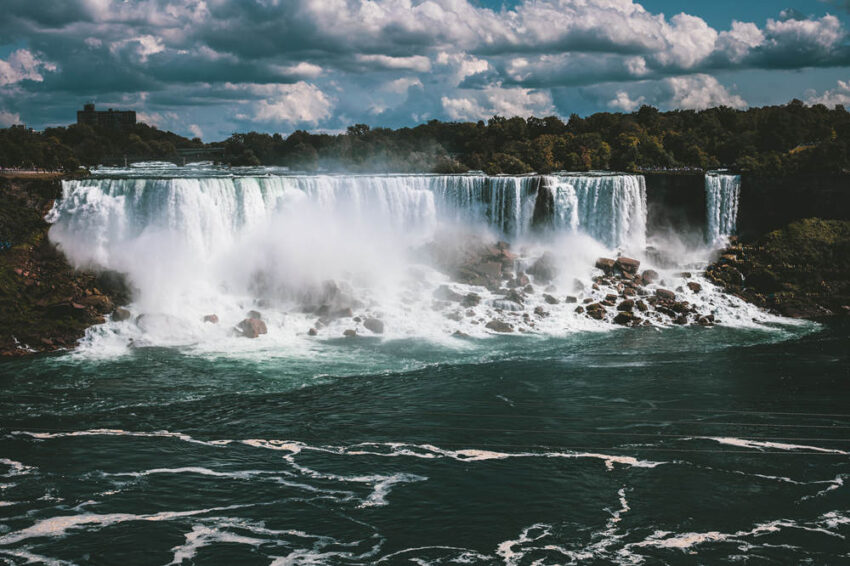
Niagara Falls is about 12,000 years old, which makes it surprisingly young in geological terms. The waterfall began forming near the end of the last Ice Age, when meltwater from the upper Great Lakes drained toward Lake Ontario and began cutting through the rock of the Niagara Escarpment.
That number is only part of the story. The Falls are young, but the rock beneath them is ancient. The landscape visitors see today was shaped by glaciers, flowing water, layered stone, and thousands of years of erosion.
Quick Answers
| Question | Answer |
|---|---|
| How old is Niagara Falls? | About 12,000 years old |
| What created it? | Ice Age meltwater, the Niagara River, and erosion |
| Where did the Falls begin? | Near the Queenston-Lewiston area |
| Has Niagara Falls moved? | Yes, it has moved upstream over thousands of years |
| Is it still changing? | Yes, but much more slowly than in the past |
Why Niagara Falls Is Considered Geologically Young
To most people, 12,000 years sounds incredibly old. It reaches back long before modern cities, written records, or the Niagara region as we know it today. In geology, however, 12,000 years is a short amount of time.
Many landforms are measured in millions of years. Niagara Falls is different because the waterfall itself formed after the last Ice Age. The rock layers that helped shape it are much older.
The New York State Museum explains that many of the rocks visible around Niagara Falls were deposited during the Silurian Period, roughly 440 to 425 million years ago. These ancient layers include limestone, shale, sandstone, and dolostone. Some are harder and more resistant, while others wear away more easily.
That mix of rock types helped determine how the Falls formed and why they moved. So the clearest way to answer the age question is this: Niagara Falls as a waterfall system is about 12,000 years old, while the rocks that guide and support it are hundreds of millions of years older.
How the Ice Age Helped Create Niagara Falls
The story of Niagara Falls begins with ice.
During the last Ice Age, thick glaciers covered much of this region. As the climate warmed, the ice slowly retreated. Meltwater filled low areas, reshaped drainage routes, and helped form the Great Lakes system.
As that water moved from the upper Great Lakes toward Lake Ontario, it flowed through what became the Niagara River. When the river crossed the Niagara Escarpment, it dropped over a rocky ledge. That drop became the beginning of Niagara Falls.
Niagara Falls State Park describes the Falls as geologically young, with water first plunging over the Niagara Escarpment about 12,000 years ago. The process was not a single dramatic moment. It was a long natural sequence shaped by glacial retreat, river flow, rock structure, and erosion.
Over time, the falling water cut deeper into the landscape. The Falls changed shape, shifted position, and began carving the gorge that remains one of the most dramatic features of the Niagara region.
Where Niagara Falls First Began
Niagara Falls did not start exactly where visitors see it today.
The earliest version of the waterfall formed downstream near the Queenston-Lewiston area, close to the edge of the Niagara Escarpment. From there, the Falls slowly moved upstream toward their present location.
This movement happened because water constantly wore away the rock at and below the crest of the waterfall. Softer layers eroded first. Harder rock above them lost support and eventually broke away. Each collapse moved the edge of the waterfall slightly farther upstream.
Over thousands of years, that process created the Niagara Gorge. The gorge is not just scenery beside the river. It is the former path of the Falls, showing where the waterfall once stood as it carved its way through the landscape.
How Erosion Moved the Falls Over Time
Erosion is the main reason Niagara Falls has changed location.
The process is easier to understand when you picture the Falls as a layered structure. Water flows over harder caprock at the top, while softer rock below is gradually worn away. As the lower layers weaken, the upper ledge becomes unstable. Eventually, pieces of rock collapse, and the waterfall retreats.
This pattern repeated again and again after the Falls formed. The result was a slow upstream movement from the Queenston-Lewiston area toward the modern Horseshoe Falls, American Falls, and Bridal Veil Falls.
In the past, erosion happened more quickly because more water flowed naturally over the brink. Today, the rate is much slower. Water diversion, hydroelectric production, engineering work, and conservation planning have all changed how the river is managed.
That does not mean Niagara Falls has stopped changing. It means the changes are now more gradual than they were during much of the Falls’ natural history.
The Niagara Gorge: A Visible Timeline of the Falls
One of the best ways to understand the age of Niagara Falls is to look beyond the brink.
The Niagara Gorge stretches downstream from the Falls toward Queenston and Lewiston. Its steep walls, rushing river, layered stone, and dramatic bends all help tell the story of where the Falls used to be.
In that sense, the gorge works like a natural timeline. Each section of the gorge reflects the long movement of the waterfall through the landscape. The river did not simply appear at the bottom of a canyon. The canyon was carved by the retreating Falls and the force of the water that followed.
For visitors, this adds depth to the classic Niagara view. The Horseshoe Falls may be the most famous scene, but the gorge shows the larger story. It reminds us that Niagara Falls is not a fixed object. It is part of a living natural system shaped by water, stone, and time.
Are Niagara Falls Still Changing Today?
Yes, Niagara Falls is still changing, although much more slowly than it once did.
Water, ice, gravity, and seasonal freeze-thaw cycles still affect the rock around the Falls and gorge. The Niagara River still carries enormous force, especially in the rapids below the Falls. Over long periods, those forces continue to shape the landscape.
Modern water management also plays an important role. The International Joint Commission explains that the 1950 Niagara Treaty sets minimum flows over Niagara Falls to preserve its scenic beauty while allowing additional water to be used for hydropower.
This managed flow has helped slow erosion and preserve the familiar appearance of the Falls. Visitors still experience the sound, mist, and power of Niagara, but the river is also part of a carefully balanced system shared by Canada and the United States.
Will Niagara Falls Disappear Someday?
On a very long geological timeline, Niagara Falls will continue to evolve. Waterfalls are not permanent in the way they may seem when we stand beside them. They move, erode, collapse, shift, and eventually become something different.
That does not mean Niagara Falls is going to disappear anytime soon. The changes that matter geologically happen across thousands of years, far beyond the scale of a vacation, a lifetime, or many generations.
It is better to think of the Falls as changing rather than vanishing. The waterfall visitors see today is one chapter in a much longer story that began with Ice Age meltwater and continues through erosion, water management, and natural rock movement.
Best Places to See Niagara’s Geological Story
Knowing the age of Niagara Falls can make a visit more meaningful. Instead of focusing only on the view from the brink, visitors can look for clues throughout the surrounding landscape.
Niagara Glen
Niagara Glen is one of the best places to feel close to the geology of the gorge. Its trails pass through forest, boulders, exposed rock, and rugged terrain above the Niagara River. It offers a very different experience from the main tourist viewpoints and helps visitors understand the scale of the gorge.
The trails can be uneven and challenging in places, so visitors should check current conditions, wear proper footwear, and stay on marked paths.
The Whirlpool Area
The Whirlpool area shows the power of the lower Niagara River after it leaves the Falls. Here, the river makes a dramatic turn, creating swirling water and strong currents. It is one of the clearest places to see how forcefully the river continues to move through the gorge.
White Water Walk
White Water Walk brings visitors close to the lower river’s intense rapids. It does not show the Falls themselves, but it does show the power of the water after it has passed through the gorge. For anyone interested in how Niagara keeps shaping the landscape, this area adds helpful context.
Queenston Heights and the Lower Gorge
The Queenston-Lewiston area is important because it sits near where the Falls began their long upstream retreat. Looking from this part of the region toward the gorge helps visitors imagine how far the waterfall has moved since its earliest stages.
Rock Layers Along the Gorge
The layered rock visible near the Falls and along the gorge is part of Niagara’s story. Different layers erode at different speeds, which helped shape both the waterfall and the gorge. Even a quick look at the rock walls can make the landscape feel less like a backdrop and more like a record of deep time.
Final Thoughts
Niagara Falls is about 12,000 years old, formed when Ice Age meltwater began flowing across the Niagara Escarpment and cutting into ancient rock. That makes the waterfall young in geological terms, even though the stone around it is hundreds of millions of years old.
The Falls began near the Queenston-Lewiston area, moved upstream through erosion, and carved the Niagara Gorge along the way. Today, they continue to change more slowly, shaped by natural forces and modern water management.
For visitors, that history adds another layer to the experience. Niagara Falls is not only a famous view or a powerful rush of water. It is a living piece of natural history, shaped by ice, stone, water, and time.