
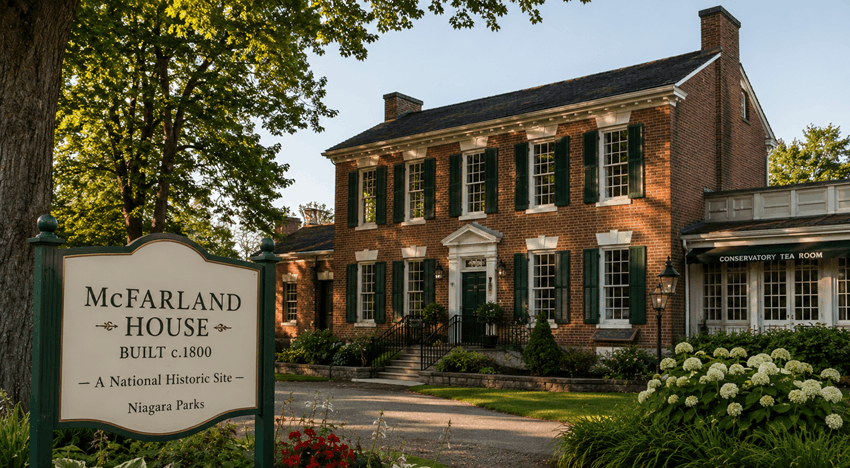
Niagara-on-the-Lake is full of beautiful buildings, quiet streets, historic plaques, and stories that seem to sit just below the surface. But few places carry the weight of early Niagara history quite like McFarland House. Built around 1800 by John McFarland and his sons, this Georgian-style home is one of the rare surviving structures in the area that predates the War of 1812.
Today, McFarland House stands along the Niagara Parkway as a heritage site, tea room, and peaceful reminder of what life looked like in colonial Niagara. It is elegant, quiet, and easy to admire. But behind its graceful exterior is a story shaped by ambition, family, war, survival, damage, restoration, and memory.
A House Built for Status and Stability
John McFarland was a Scottish-born settler who arrived in North America during a period of enormous change. He worked as a shipbuilder and became connected to the military and commercial life of early Upper Canada. By the time he built McFarland House, he was not simply putting up a family home. He was building a statement.
In 1800, a brick Georgian-style house was no small thing. The home showed success, taste, and permanence. It was built on land granted by the Crown, and its location near the Niagara River gave it both beauty and strategic importance.
McFarland and his sons are said to have made the bricks using clay from the property. That detail matters because it connects the home physically to the land around it. McFarland House was not imported into Niagara. It was shaped from Niagara soil, by a family building its future in a young and uncertain settlement.
Life in Early Niagara
To understand McFarland House, it helps to picture Niagara-on-the-Lake before it became the polished destination visitors know today. The town was once Newark, the first capital of Upper Canada. It was a military, political, and commercial centre close to the American border, surrounded by farmland, river traffic, forts, and constant tension.
A home like McFarland House would have been part private residence, part symbol of standing, and part working household. Family members, servants, visitors, tradespeople, and military figures all moved through spaces like this. The house would have reflected both comfort and labour.
Modern visitors may notice the symmetry, the windows, the formal rooms, and the graceful proportions. But the house was never just decorative. It was a living, working place where food was prepared, fires were tended, children were raised, guests were received, and daily routines followed the rhythm of the seasons.
Niagara Before the Flames
The War of 1812 changed Niagara deeply. Because of its location along the Canada-U.S. border, the Niagara frontier became one of the most important and dangerous regions of the conflict. Forts, farms, homes, roads, and river crossings all became part of the military landscape.
In December 1813, American forces retreating from Newark burned much of the town. The destruction left a lasting scar on Niagara-on-the-Lake’s history. Many buildings were lost, and families were left to rebuild in harsh winter conditions.
McFarland House survived.
That survival is one reason the home remains so important today. It gives visitors a rare physical link to the world before the burning of Newark. While much of the town had to be rebuilt after the war, McFarland House stood as a wounded but surviving witness.
A Home Turned Into a Military Site
During the War of 1812, McFarland House was used by both British and American forces. It served as a hospital and headquarters, and the land around it carried military importance because of its position near the Niagara River.
That changes the way we should look at the house. The rooms that now feel calm and restored once held injured soldiers, military officers, anxious conversations, and the practical realities of war. A fine family home became part of a conflict much larger than the family itself.
The ravine and land behind the house also played a role in the military geography of the area. The property’s location made it useful for movement, observation, and river defense. In a war where every crossing and shoreline mattered, McFarland House was more than a residence. It was part of the battlefield landscape.
John McFarland’s Personal Cost
The war did not only affect the house. It affected the man who built it.
John McFarland was taken prisoner after the American capture of Fort George in 1813. When he eventually returned, he found his property damaged and his home changed by war. The emotional impact must have been severe. For a man who had built the house as a symbol of success, stability, and family, seeing it scarred by conflict would have been devastating.
McFarland died in 1815, shortly after the war years. His family repaired and continued to live in the house, preserving it through generations. That continuity is one of the most remarkable parts of the story. The house did not become history right away. It remained a home.
Generations Under One Roof
McFarland House stayed connected to the McFarland family for many years. That long family presence gives the house depth beyond its War of 1812 story.
Historic homes can sometimes become frozen around one dramatic event, but real homes carry many layers. McFarland House was a place of births, meals, work, grief, repairs, changing fashions, family decisions, and ordinary days. It changed over time, including later additions and adaptations that reflected the needs of new generations.
That is part of what makes it interesting. It is not only a war landmark. It is a family landmark. It shows how a home can move through history while still remaining connected to the people who lived there.
From Private Home to Heritage Site
By the 20th century, McFarland House had become an important preservation concern. The Niagara Parks Commission eventually acquired the property, restored it, and opened it to the public as a historic site in 1959.
That transition helped protect one of Niagara’s most significant surviving homes. Without preservation, buildings like this can easily disappear through neglect, redevelopment, fire, or simple wear over time.
Today, visitors can tour the house and learn about early 19th-century life, the McFarland family, and the home’s wartime role. Costumed interpreters and heritage programming help bring the space to life, giving people more than a quick look at old furniture.
The Beauty of Georgian Design
One of the reasons McFarland House remains so visually appealing is its Georgian style. Georgian architecture is known for balance, symmetry, proportion, and restraint. It does not need to be loud to feel impressive.
The design reflects a world where architecture communicated order and status. The placement of windows, the structure of rooms, and the formal feel of the house all speak to the tastes of the period.
For modern visitors, that elegance is part of the attraction. McFarland House feels graceful without being showy. It has the kind of quiet presence that suits Niagara-on-the-Lake perfectly.
The Tea Room Experience
One of the most charming parts of McFarland House today is its tea room. The Conservatory Tea Room gives visitors a way to enjoy the property slowly, not just tour it and leave.
Afternoon tea fits the setting beautifully. Tea, scones, pastries, quiet conversation, and garden views all help turn a historic visit into a fuller experience. It also connects the house to Niagara-on-the-Lake’s hospitality culture, where history, food, gardens, and leisure often overlap.
The tea room is especially appealing because it does not feel disconnected from the site’s identity. It gives guests a way to spend time in the atmosphere of the property while still enjoying modern comfort.
McFarland Park and the Niagara Parkway
McFarland House is also helped by its setting. It sits within McFarland Park along the Niagara Parkway, one of the most scenic drives in the region. The surrounding parkland offers space for walking, picnicking, cycling, and enjoying the slower side of Niagara.
That setting matters. The house is not hidden in a dense urban block. It has room to breathe. Visitors can imagine the importance of the river, the landscape, and the property’s position in early Niagara life.
The Niagara Parkway itself connects many of the region’s major historic and natural sites. McFarland House fits naturally into a day that might include Fort George, Queenston Heights, the Laura Secord Homestead, the Niagara River Recreation Trail, and Old Town Niagara-on-the-Lake.
Why McFarland House Still Matters
McFarland House matters because it helps make history physical. Reading about the War of 1812 is one thing. Standing inside a house that survived it is different.
The home reminds visitors that history did not happen only in forts, battlefields, and government buildings. It happened in family homes. It happened in kitchens, bedrooms, gardens, and parlours. It happened to people who were trying to build lives while larger forces moved around them.
That is what makes McFarland House powerful. It connects public history with private life.
A Quieter Kind of Niagara Attraction
Niagara is famous for big experiences: the Falls, wineries, theatres, busy streets, boat tours, and major attractions. McFarland House offers something quieter.
It asks visitors to slow down. Look at the rooms. Think about the people who lived there. Notice the landscape. Imagine soldiers passing through, family members rebuilding after war, and later generations preserving a home they had inherited.
That slower pace is valuable. Not every Niagara experience needs to be dramatic. Some of the best ones are reflective.
Planning a Visit
McFarland House operates seasonally, and hours, tours, tea room service, and special events can change. Anyone planning a visit should check current details through Niagara Parks before going.
It is a good stop for history lovers, architecture fans, couples, families, garden visitors, and anyone building a quieter Niagara-on-the-Lake itinerary. It can also pair well with afternoon tea, a walk along the parkway, or a broader heritage route through the region.
Give yourself time. This is not a place to rush through only to say you saw it. The house is best appreciated slowly.
Final Thoughts
McFarland House is one of Niagara-on-the-Lake’s most meaningful historic landmarks because it has lived many lives. It was a family home, a symbol of success, a wartime hospital, a military site, a damaged survivor, a restored residence, and now a public heritage destination.
Its story reaches back to the earliest years of Upper Canada and runs directly through the War of 1812. Yet it also remains welcoming today, with tours, parkland, gardens, and tea that invite visitors to experience history in a more personal way.
In a town known for beauty and history, McFarland House stands out because it is not only beautiful. It endured.
That endurance is what makes it worth visiting, remembering, and protecting.