
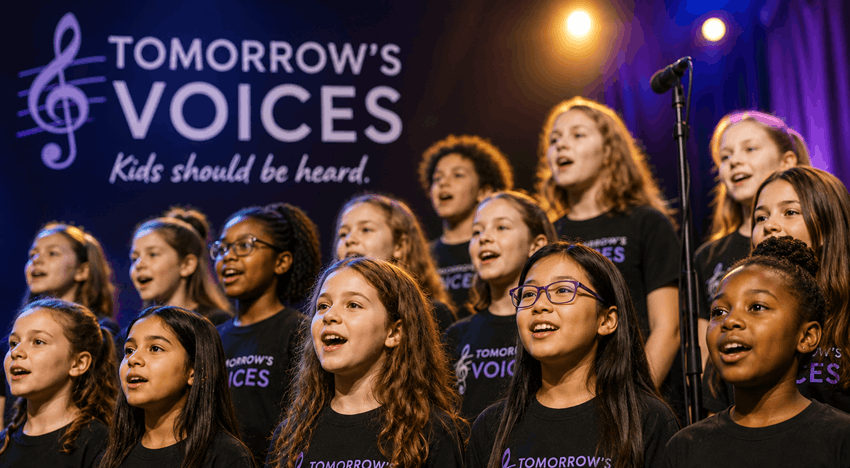
Music has a way of reaching kids before words always can. A song can build confidence, ease stress, create friendships, and give young people a safe place to express who they are. That is the heart of Tomorrow’s Voices, a barrier-free children’s choir program that began in Niagara and has grown into a powerful example of how the arts can change lives.
At its core, Tomorrow’s Voices is built on one simple belief: kids should be heard. Not only the kids who can afford private lessons. Not only the kids who already know how to read music. Not only the kids who feel brave enough to audition. All kids.
A Choir Built Around Access
Tomorrow’s Voices offers free after-school choir programs for children and youth. The program is designed to remove the barriers that often keep young people from participating in the arts. There are no audition requirements. There are no participation fees. The focus is not on perfection, competition, or pressure.
The focus is on singing, belonging, learning, and being part of something bigger than yourself.
That matters because access to music education is not equal for every child. Some families can afford private lessons, instruments, transportation, camps, and performance programs. Others cannot. Some schools have strong music programs. Others have limited arts funding or few extracurricular options.
Tomorrow’s Voices helps close that gap by creating a place where kids can show up, sing, and grow without needing money, experience, or special training first.
The Niagara Roots of Tomorrow’s Voices
The program was founded by Todd Green, a Brock University professor with a deep interest in music, community, and the social value of the arts. What began as a Niagara-based idea has grown into a larger charitable effort with choir programs in several Canadian communities.
Green’s background is part of what makes the story interesting. He is not only a music lover. His academic work has also explored ethics, corporate responsibility, and the role of arts and entertainment in society. Tomorrow’s Voices brings those ideas into real life.
Instead of treating music as something only for people with formal training, the program treats music as a tool for connection. It gives kids a way to develop confidence, teamwork, discipline, empathy, and self-expression.
Why Singing Together Works
There is something special about a choir because no one voice has to carry the whole song. Each singer matters, but the sound becomes stronger when everyone participates.
That is a powerful lesson for young people. In a choir, kids learn to listen as much as they sing. They learn timing, patience, cooperation, and trust. They learn that their voice has value, but also that other voices matter too.
For children who may feel shy, isolated, anxious, or unsure of themselves, that can be life-changing. They do not have to stand alone at centre stage. They can stand with others and still be heard.
That balance is one of the most beautiful things about choir singing. It gives kids both community and courage.
More Than a Music Program
Tomorrow’s Voices is often described as a children’s choir, but it is also more than that. It is a youth development program, a confidence-building space, a community arts project, and a support system.
Through regular rehearsals and performances, participants get a chance to build skills over time. They learn songs, work with music directors, practice performance etiquette, and experience the excitement of sharing music with an audience.
But the growth goes beyond the music. Kids also learn how to show up consistently, support each other, manage nerves, follow direction, and take pride in their progress.
Those are skills that can carry into school, friendships, future jobs, and personal life.
A Safe Place to Be Creative
Children need places where they can be expressive without being judged too harshly. Tomorrow’s Voices creates that kind of space.
The program is not built around the idea that every child must become a professional singer. That is not the point. The point is to give young people a healthy outlet, a supportive group, and a reason to feel proud of their voice.
That can be especially important for kids who do not always feel seen in other settings. Some children may not connect with competitive sports. Some may not have access to private arts programs. Some may be carrying stress that they do not know how to explain.
Music gives those kids another language.
The Power of Performing
Performing can be scary, but it can also be deeply empowering. When kids step on stage with a choir, they experience the rush of being part of something public and meaningful.
They learn that nerves are normal. They learn that practice matters. They learn that an audience can be welcoming. They learn that their work can move people.
For a child, that feeling can stay with them. A performance may last only a few minutes, but the memory of standing with friends and singing confidently can last much longer.
Tomorrow’s Voices has given children opportunities to perform at community events, arts spaces, and special gatherings. Those moments help young singers see themselves not just as participants, but as contributors to the cultural life of their community.
Why Programs Like This Matter in Niagara
Niagara has a rich arts and culture scene, but access is still a real issue. Families across the region do not all have the same resources, transportation options, school supports, or extracurricular opportunities.
A free, welcoming choir program helps make the arts more democratic. It tells young people that music is not only for those who can pay for it. It is for anyone willing to show up and sing.
That message fits Niagara well. The region has strong community roots, local pride, and a long history of people stepping forward to support children, families, and neighbourhoods. Tomorrow’s Voices adds to that tradition by using music as the bridge.
Growing Beyond One City
What started in St. Catharines has grown beyond one local choir. Tomorrow’s Voices now operates in multiple communities, showing that the need for accessible youth music programs is not limited to Niagara.
That growth says something important. When a program is built on a clear need, people respond. Parents respond. Kids respond. Volunteers respond. Donors and community partners respond.
The model is simple but powerful: remove the barriers, provide strong leadership, create a safe environment, and let kids discover what they can do together.
As the program expands, the original Niagara story becomes part of a larger national conversation about arts access, youth confidence, and community-building through music.
The Role of Music Directors and Mentors
A children’s choir depends heavily on the adults leading it. A good music director does more than teach notes. They create energy in the room. They choose songs that young people can connect with. They make rehearsals feel safe, fun, and meaningful.
For kids, that leadership matters. A supportive adult can help a nervous child try again. A thoughtful song choice can help a group connect with the lyrics. A patient rehearsal can turn uncertainty into confidence.
Tomorrow’s Voices places strong emphasis on professional, engaging music leadership. That keeps the program both joyful and structured.
Choosing Songs Kids Can Feel
Song choice is a big part of what makes a youth choir work. Kids need music that feels alive to them. They need melodies they can enjoy, lyrics they can understand, and arrangements that let them experience harmony without feeling overwhelmed.
Popular music, uplifting songs, and emotionally clear lyrics can all help young singers connect with the material. When kids relate to a song, they sing differently. They stand taller. They listen more closely. They begin to understand that music is not only about sound. It is about feeling.
That connection is part of what turns a rehearsal into something memorable.
Confidence Without Pressure
One of the strongest parts of Tomorrow’s Voices is that it gives kids confidence without making the environment feel harsh or competitive.
In many performance settings, children can feel pressure to be perfect. That pressure may help some kids improve, but it can also push others away. Tomorrow’s Voices takes a different approach. The goal is growth, not fear.
That does not mean the program lacks standards. Kids still learn. They still rehearse. They still work toward performances. But the atmosphere is built around encouragement rather than intimidation.
That kind of confidence is healthier because it lasts. A child who feels safe to make mistakes is more likely to keep learning.
How the Community Can Support Tomorrow’s Voices
A barrier-free program still needs support. Free programs are never truly free to run. They need rehearsal space, transportation help, music directors, administration, snacks, events, communication, and community partnerships.
That is where supporters matter.
People can help by donating, sponsoring, volunteering, attending performances, sharing the program with families, connecting the organization with community partners, or simply talking about why youth arts access matters.
Businesses can also play a role. Supporting a children’s choir is not only a charitable gesture. It is an investment in confidence, creativity, and community health.
Why Arts Funding Deserves Attention
Sports funding often gets more attention, and athletics can absolutely be valuable for young people. But arts programs deserve the same respect.
Music teaches discipline, teamwork, memory, listening, emotional expression, and cultural awareness. It helps kids build identity and belonging. It gives them a way to process feelings and connect with others.
For some children, the arts are not an extra. They are the place where they finally feel like themselves.
Programs like Tomorrow’s Voices remind communities that a healthy childhood should include more than academics and athletics. It should include creative expression too.
The Bigger Meaning of “Kids Should Be Heard”
The slogan behind Tomorrow’s Voices carries more meaning than a clever phrase. “Kids should be heard” challenges an old idea that children should stay quiet, behave, and fit into the background.
Children need guidance, yes. But they also need room to speak, sing, question, create, and be recognized.
When a child sings in a choir, they are not only making music. They are learning that their voice belongs in the room. That lesson can shape how they see themselves long after the song ends.
A Niagara Story Worth Continuing
Tomorrow’s Voices began with a simple idea and grew because the idea was needed. It gave children a place to sing without financial barriers. It gave communities a way to support youth through the arts. It gave Niagara another example of how local passion can become something much larger.
The program’s growth shows what can happen when people take children’s creativity seriously. A choir may seem like a small thing from the outside. But for the kids inside it, it can become a source of friendship, confidence, joy, and belonging.
Final Thoughts
Supporting Tomorrow’s Voices means supporting more than music. It means supporting children who deserve access to the arts. It means supporting confidence, friendship, emotional expression, and community connection.
Every child deserves a chance to be heard. Tomorrow’s Voices gives young people that chance one rehearsal, one song, and one performance at a time.
For Niagara and every community touched by the program, that is something worth singing about.