
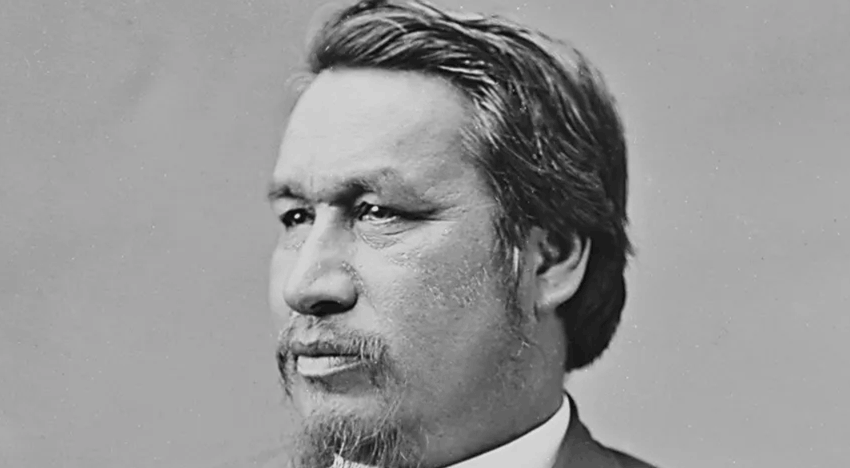
Ely Parker’s life reads like a story that should be better known. He was a Seneca leader, engineer, military officer, diplomat, legal thinker, and one of the key men in the room when the American Civil War moved toward its end.
At Appomattox Court House in April 1865, Parker stood beside Ulysses S. Grant as Robert E. Lee surrendered the Army of Northern Virginia. Parker helped write the final surrender terms, placing his handwriting on one of the most important documents in American history. Yet his story goes far beyond that one moment.
A Seneca Life With Deep Roots
Ely Samuel Parker was born Hasanoanda in 1828 on the Tonawanda Seneca Reservation in western New York. He was part of the Seneca Nation, one of the nations of the Haudenosaunee Confederacy.
His family background connected him to leadership, diplomacy, and the long struggle of Native people to protect land, identity, and sovereignty. Parker grew up in a world shaped by both Seneca tradition and the pressure of expanding American power.
That pressure was not abstract. During Parker’s youth, the Tonawanda Seneca faced land-loss threats tied to treaties and outside land companies. For Parker, public life began not with ambition for fame, but with a practical need: his people needed someone who could speak, write, negotiate, and defend their interests in a world that often refused to treat Native nations fairly.
Learning the Language of Power
One of the most important parts of Parker’s early life was his decision to master English. According to accounts of his youth, he once felt the sting of being unable to fully understand English-speaking men around him. That experience pushed him to become fluent.
For Parker, language became a tool of survival and influence. He understood that words could protect land, open doors, settle disputes, and challenge unfair systems. His command of English did not make him less Seneca. It gave him another way to fight for Seneca interests.
He studied in schools, worked with scholars, and developed a sharp legal mind. He later studied law in New York and had the knowledge needed to practice. But the state would not admit him to the bar because Native Americans were not recognized as U.S. citizens at the time.
That rejection was a clear example of the barriers Parker faced. He had the ability. He had the training. What he did not have was a legal system willing to recognize him equally.
From Law to Engineering
Blocked from practicing law, Parker turned to engineering. He worked on public projects and proved himself capable in another demanding field.
This shift says a lot about him. Some people are stopped by one closed door. Parker found another way forward. His engineering work eventually took him to Galena, Illinois, where he met Ulysses S. Grant before Grant became one of the most famous military figures in American history.
That meeting would change Parker’s life. It also changed the way his talents would be used during the Civil War.
A Leader for the Tonawanda Seneca
Even as Parker built a career outside his home community, he remained deeply connected to the Tonawanda Seneca. His legal training, language skills, and diplomatic ability made him valuable in the fight to protect Seneca land.
He worked on negotiations and helped defend the rights of his people at a time when Native communities were often pushed aside by government policy, private companies, and public prejudice.
Parker was later recognized as a Seneca sachem and given the name Donehogawa, often translated as “Open Door.” That name fits the pattern of his life. He moved between governments, cultures, institutions, and expectations, opening paths where others had tried to close them.
Trying to Serve During the Civil War
When the Civil War began, Parker tried to serve the Union. At first, he was rejected. His race and Native identity were used as reasons to keep him out, even though he had the skills the army needed.
Eventually, his connection with Grant helped change that. Parker received a commission and joined the Union war effort. His engineering background and administrative skill made him useful, but it was his calm intelligence and reliability that helped him rise.
He became part of Grant’s staff and served as a military secretary. That role required discipline, trust, and precision. Parker handled correspondence, documents, and sensitive military communication. He was close to the center of Union command during some of the war’s most important stages.
The Appomattox Moment
On April 9, 1865, Grant and Lee met at Appomattox Court House in Virginia. The meeting effectively ended the fighting between the Union Army and Lee’s Army of Northern Virginia, though other Confederate forces surrendered later.
Parker was in the room as a member of Grant’s staff. His presence carried deep meaning, even if many people at the time did not fully understand it.
Here was a Seneca man, once blocked from practicing law because he was not considered a citizen, helping record the surrender terms that helped close the Civil War. He was not standing outside history. He was writing it.
One famous story from that day says Lee looked at Parker and remarked that he was glad to see “one real American” present. Parker’s reported reply was simple and powerful: “We are all Americans.”
Whether read as grace, diplomacy, or moral clarity, the response has become one of the most quoted moments of Parker’s life.
More Than Grant’s Secretary
It would be a mistake to remember Ely Parker only as the man who wrote the surrender terms. That moment was important, but it was one chapter in a larger life.
Parker’s career brought together several forms of service. He served the Seneca Nation. He served as an engineer. He served in the Union Army. He advised Grant. He later became the first Native American to serve as Commissioner of Indian Affairs.
Each role placed him inside systems that often treated Native people unfairly. That made his work complicated. Parker had to navigate power from the inside while still carrying the knowledge of what that power had done to Native communities.
Commissioner of Indian Affairs
After Grant became president, he appointed Parker as Commissioner of Indian Affairs in 1869. It was a historic appointment. Parker became the first Native American to hold the office.
The position was difficult from the start. The federal government’s policies toward Native nations were shaped by paternalism, pressure, broken promises, and expansion. Parker entered the role with knowledge, experience, and a desire to reduce violence, but he was working inside a deeply flawed system.
His time as commissioner was brief and controversial. He faced accusations related to government purchasing, though he was not convicted of fraud. The political pressure damaged his authority, and he resigned in 1871.
That ending was painful. Parker had reached one of the highest offices connected to Native affairs, but the system around him remained resistant, suspicious, and unstable.
A Life of Barriers and Achievements
Parker’s life shows a painful contrast. He was talented enough to serve beside Grant, write historic military documents, advise presidents, and lead in public office. Yet he was also denied basic recognition because of racist laws and attitudes.
He studied law but was blocked from the bar. He tried to serve in the army but was initially rejected. He rose in government but faced political attacks. He moved through powerful institutions, but those institutions never fully belonged to him.
That tension makes his story more human and more important. Parker was not simply a symbol of success. He was a person who achieved extraordinary things while dealing with systems designed to limit people like him.
Recognition That Came Far Too Late
In recent years, Parker’s legal story gained renewed attention. More than a century after his death, he was posthumously admitted to the New York State Bar. The recognition corrected, at least symbolically, the injustice that had kept him from practicing law during his lifetime.
That late honor matters because it shows how history can be revisited with clearer eyes. Parker did not lack the qualifications. The law lacked fairness.
His posthumous admission also helps modern readers understand the larger problem. Native people were often expected to adapt to American systems while being denied equal standing inside those same systems. Parker’s life exposes that contradiction clearly.
Why Ely Parker Still Matters
Ely Parker matters because he forces us to look at history from more than one angle.
He was present at a defining Civil War moment, but he was not only a Civil War figure. He was a Seneca leader, but his work extended beyond one community. He served the United States, but he also knew how often the United States failed Native nations. He became a government official, but he understood the cost of government policy in Native lives.
That complexity is exactly why his story should be remembered.
Simple history likes clean labels: soldier, chief, engineer, secretary, commissioner. Parker was all of those and more. His life sat at the meeting point of Native sovereignty, American expansion, war, law, citizenship, diplomacy, and identity.
The Niagara and Western New York Connection
For readers in Niagara and western New York, Parker’s story also has regional meaning. His life was rooted in the lands and communities near the Niagara Frontier, where Haudenosaunee history is central to the region’s deeper identity.
Too often, local history is told through forts, battles, canals, tourism, and settlement stories, while Indigenous leadership is pushed to the margins. Parker’s life helps correct that imbalance.
He reminds us that the history of this region is not only about colonial borders or famous military names. It is also about Native nations, treaty struggles, diplomacy, language, land, and leaders who shaped events far beyond their home communities.
Remembering the Whole Person
The most respectful way to remember Ely Parker is not to flatten him into one famous scene at Appomattox. That moment matters, but it should not swallow the rest of his life.
He was a child who learned English because he understood the power of language. He was a young man denied a legal career because of discrimination. He was a Seneca leader who fought for land rights. He was an engineer who built a career through skill. He was a military officer trusted by Grant. He was a commissioner asked to lead inside a broken system. He was a husband, father, advocate, and public servant.
His life was not easy. It was not simple. That is what makes it worth studying.
Final Thoughts
Ely Parker’s story belongs in any serious telling of Civil War history, Native history, and the history of western New York. He helped write the terms that marked the beginning of the Civil War’s end, but his greater legacy is the way he moved through a world that repeatedly tried to deny his place in it.
He used language, law, engineering, diplomacy, and military service as tools. He fought for the Tonawanda Seneca. He served beside one of the most powerful men in the United States. He became the first Native American Commissioner of Indian Affairs. And long after his death, the legal profession finally recognized what should have been obvious in his lifetime: Ely Parker belonged.
His name deserves to be remembered not as a footnote, but as a full chapter.
image source: battlefields.org