
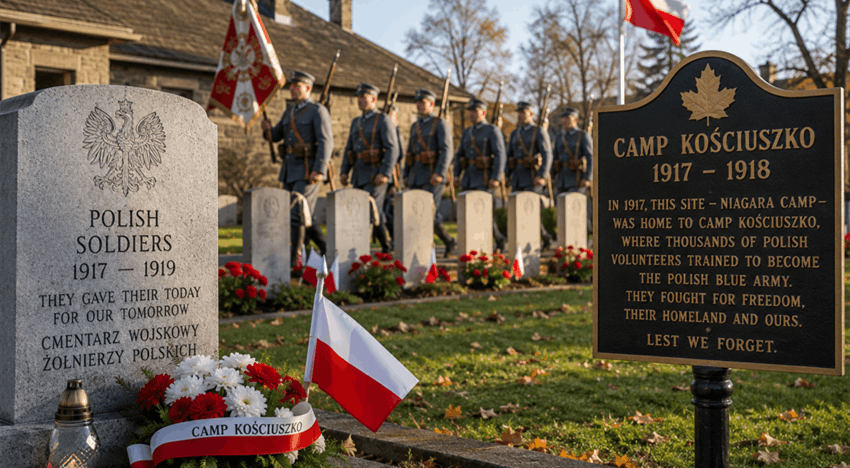
Niagara-on-the-Lake is often remembered for its heritage streets, wineries, theatres, historic forts, and quiet lakeside charm. But during the First World War, this small Ontario town became part of a much larger international story. From 1917 to 1919, Niagara-on-the-Lake helped train thousands of Polish volunteers who hoped to fight for the freedom of a country many had never seen, but still called their homeland.
Their training ground was known as Camp Kościuszko, located at Niagara Camp. The soldiers who passed through it became part of the Polish Army in France, often remembered as the Blue Army because of the French blue uniforms they wore. Their story connects Niagara-on-the-Lake to Poland’s long struggle for independence, the Polish diaspora in North America, Canada’s wartime role, and a remarkable tradition of remembrance that continues more than a century later.
Poland’s Long Road Back to Independence
To understand why Polish volunteers came to Niagara-on-the-Lake, it helps to understand Poland’s situation before the First World War.
For more than a century, Poland did not exist as an independent nation on the map of Europe. In the late 1700s, Poland had been divided among Russia, Prussia, and Austria. Generations of Polish families grew up under foreign rule, and many left Europe for North America, carrying with them a strong sense of Polish identity.
By the time the First World War began, Polish communities in the United States and Canada saw a rare chance. If the old empires weakened or collapsed, Poland might be restored as an independent country. For many Polish immigrants and their children, the war was not only a European conflict. It was an opportunity to help bring back a homeland.
Why Niagara-on-the-Lake Became the Training Site
Niagara-on-the-Lake already had military history by the time the Polish volunteers arrived. Niagara Camp had been used to train soldiers during the First World War, and the area had long-standing military connections because of its location near the Niagara River and the Canada-U.S. border.
When plans formed to create a Polish force that could fight with the Allies, Canada agreed to help train volunteers. France supported and financed the army, while Polish organizations in North America helped recruit men. The United States had its own policy concerns early in the war, so Canada became the practical place where many Polish-American volunteers could train before being sent overseas.
That is how a small Ontario town became home to Camp Kościuszko, a training camp named after Tadeusz Kościuszko, the Polish military leader remembered for his role in both Polish and American history.
Who Were the Polish Volunteers?
Many of the men who came to Camp Kościuszko were Polish Americans. Others came from Canadian Polish communities. Some were recent immigrants. Some were children of immigrants. Some may have spoken Polish at home but had never lived in Poland themselves.
What united them was a sense of duty to a country divided by foreign powers. They were not simply joining a regular army for a standard military career. Many believed they were helping restore a nation.
Polish organizations played an important role in recruitment. Groups such as the Polish Falcons helped prepare and encourage volunteers, drawing on physical training, community networks, patriotic culture, and a deep commitment to Polish independence.
For the young men who crossed into Niagara-on-the-Lake, the decision was serious. They were leaving jobs, families, and communities behind. They were entering military training with the expectation that they would soon be sent across the Atlantic into a war that had already taken millions of lives.
Life at Camp Kościuszko
Camp life was demanding. Recruits trained in military discipline, marching, drilling, weapons use, physical conditioning, and the routines required to turn volunteers into soldiers. Many had never experienced anything like it before.
Niagara-on-the-Lake was a small community, and the arrival of thousands of recruits changed the rhythm of local life. Soldiers trained, marched, attended religious services, joined public events, and interacted with residents. At times, the number of men connected to the camp could feel enormous compared with the size of the town.
The camp also reflected a mix of cultures and languages. Polish identity shaped the purpose of the training, Canadian officers helped provide instruction, and France played a major role in outfitting and supporting the army. It was a North American training camp for a Polish force that would fight in Europe under Allied command.
Why They Were Called the Blue Army
The Polish Army in France became widely known as the Blue Army because its soldiers wore French blue uniforms. The name became closely tied to General Józef Haller, who later commanded the force. Because of that connection, the army is also often called Haller’s Army.
The Blue Army became an important symbol for Polish independence. It gathered Polish volunteers from different parts of the world and gave them a military structure at a time when Poland itself had not yet fully returned as a sovereign state.
For the men trained at Camp Kościuszko, the uniform meant more than clothing. It represented the hope that Poland could stand again among nations.
From Niagara to Europe
After training in Niagara-on-the-Lake, many volunteers were sent overseas to join the Polish Army in France. There, they became part of the Allied war effort on the Western Front and later part of the broader military story connected to Poland’s rebirth.
In 1918, the First World War ended and Poland regained independence after more than a century of partition. That does not mean the struggle was simple or complete. The years that followed were filled with political, military, and territorial challenges. But for the Polish volunteers who had trained in Niagara-on-the-Lake, the cause they had joined had become real.
Their training in a small Canadian town helped support a much larger national dream.
The Influenza Tragedy
The story of Camp Kościuszko is not only one of patriotism and military service. It is also a story of loss.
During the 1918 influenza pandemic, illness swept through military camps and communities around the world. Camp Kościuszko was not spared. A number of Polish recruits died while training in Niagara-on-the-Lake, far from the homes and families they had left behind.
Their graves became a lasting reminder of the human cost of the camp. Today, the Polish military burial area in Niagara-on-the-Lake is one of the most moving pieces of this history. It connects the town not only to wartime service, but also to grief, care, and memory.
Elizabeth Ascher and Local Care
One of the most important local figures connected to this story is Elizabeth Ascher, a Niagara-on-the-Lake journalist and community member who helped care for sick soldiers during the influenza outbreak.
Her role matters because it shows that the town’s connection to the Polish volunteers was not only official or military. It was personal. Local residents saw these men, cared for them, reported on them, supported them, and helped preserve their memory after the war.
Ascher’s work has become an important part of the Camp Kościuszko story. She represents the quieter side of history: the people who step forward during crisis, often without seeking attention, and help make remembrance possible.
The Annual Pilgrimage
More than a century later, the soldiers of Camp Kościuszko are still remembered in Niagara-on-the-Lake. Each year, members of the Polish community, local residents, officials, veterans’ groups, and visitors gather to honour the men who trained there and those who died.
The annual pilgrimage is one of the strongest signs that this history is still alive. It is not a forgotten footnote. It is a living act of remembrance carried forward by families, community groups, historians, and people who understand what the camp meant to Poland and to Canada.
The ceremony also shows how deeply this story connects both countries. For Polish Canadians and Polish Americans, the site represents sacrifice and national memory. For Niagara-on-the-Lake, it is a reminder that the town played a meaningful role in an international struggle for freedom.
Why This Story Still Matters
The story of Polish patriots in Niagara-on-the-Lake matters because it challenges the way we often think about local history. A small town can be connected to world events. A quiet cemetery can hold an international story. A military camp that existed for only a short time can leave a legacy that lasts for generations.
It also matters because it shows how immigrant communities shaped the First World War. The men who trained at Camp Kościuszko were part of the Polish diaspora. Many had built lives in North America, yet they remained connected to the fate of Poland. Their service shows how identity can cross borders, languages, and generations.
There is also a Canadian story here. Canada provided the training ground, officers, and local support that helped make the camp possible. Niagara-on-the-Lake became a place where Polish independence, Allied strategy, immigrant patriotism, and Canadian wartime service all met.
Visiting the History Today
For anyone interested in local history, the Camp Kościuszko story adds depth to a visit to Niagara-on-the-Lake. The town is beautiful, but it is also layered with memory. Behind the shops, restaurants, heritage homes, and scenic views are stories of war, migration, illness, sacrifice, and international connection.
Visitors who want to understand this history can look for information from the Niagara-on-the-Lake Museum, Veterans Affairs Canada, and local heritage sources. The Polish burial plot and related commemorations offer a quiet but powerful reminder of the volunteers who trained here.
This is not the kind of history that shouts. It asks people to slow down, read the plaques, notice the flags, and think about how far these men travelled for the idea of a free Poland.
A Niagara Story With Global Meaning
Camp Kościuszko was active for only a brief period, but its impact reached far beyond Niagara-on-the-Lake. Thousands of Polish volunteers trained there. Many went on to serve in Europe. Some never returned. Others became part of the larger story of Poland’s independence after the First World War.
The town’s role in that story should not be overlooked. Niagara-on-the-Lake was not only a scenic place by the water. For a short but important time, it was a training ground for men who believed they were helping bring a nation back to life.
Final Thoughts
The Polish patriots who came to Niagara-on-the-Lake in 1917 and 1918 carried a powerful hope with them. They wanted to fight for a Poland that had been erased from the map but not from memory.
Camp Kościuszko gave that hope a place to form. It turned volunteers into soldiers, connected North America to Poland’s struggle, and left Niagara-on-the-Lake with a story that still deserves attention.
Today, the graves, plaques, museum work, and annual pilgrimage keep that memory alive. They remind us that history is not always found only in famous capitals or major battlefields. Sometimes, it is found in a quiet cemetery, a local museum, and a small town that once helped train an army for freedom.