
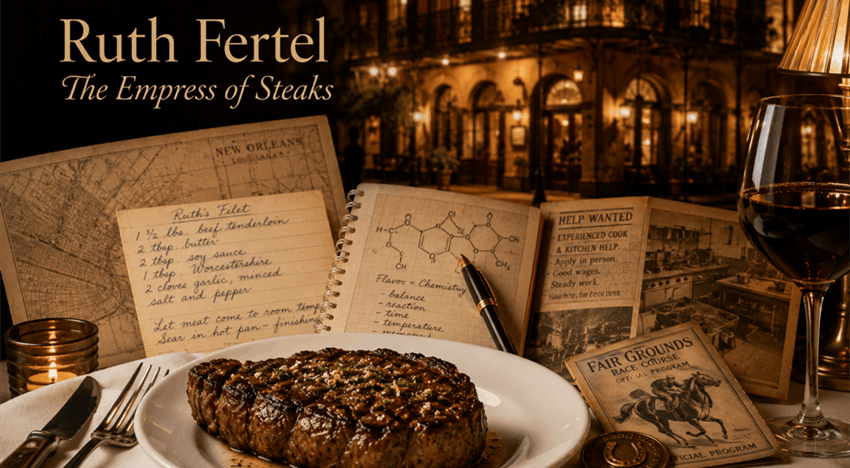
Ruth Fertel did not begin as a restaurant expert. She did not have a famous chef’s résumé, a family restaurant dynasty, or a safe business plan. She was a divorced mother of two in New Orleans who needed more money, took a dangerous chance, and turned one small steakhouse into one of the most recognizable restaurant names in North America.
Her story is not just about steak. It is about risk, instinct, hard work, hospitality, and a woman who refused to wait for permission.
From New Orleans Roots to a Different Kind of Future
Ruth Fertel was born Ruth Ann Udstad in New Orleans in 1927. She grew up in modest circumstances and showed early signs of being unusually bright. She moved quickly through school, graduated from high school at 15, and went on to study chemistry and physics at Louisiana State University.
That scientific background may seem far away from the steakhouse world, but it says something important about Ruth. She was analytical. She was not afraid of difficult work. She could learn systems, solve problems, and stay calm under pressure.
Before she became famous for steaks, she taught briefly, married Rodney Fertel, raised two sons, and became involved in horse training. She also earned recognition as Louisiana’s first licensed female horse trainer, another sign that she was comfortable stepping into spaces where women were not always expected.
Her marriage eventually ended, and Ruth found herself supporting her sons while trying to build a stable future. She worked as a lab technician at Tulane University School of Medicine and made extra income where she could. But she knew the money would not be enough, especially if she wanted to help her sons go to college.
The Classified Ad That Changed Everything
In 1965, Ruth saw a classified ad for a restaurant for sale. It was called Chris Steak House, a small 60-seat restaurant in New Orleans. The price was high for her situation, and buying it was a serious gamble.
Friends, advisers, and professionals warned her not to do it. She had no real restaurant experience. She did not know how to butcher meat. She did not have a big financial cushion. She was a single mother entering a tough, male-dominated business.
Ruth bought it anyway.
She mortgaged her home and stepped into a world she had to learn from the ground up. That decision could have ruined her. Instead, it became the beginning of a restaurant empire.
Learning the Business by Doing the Work
Ruth Fertel’s success did not come from standing in the dining room and giving orders. She learned the restaurant business by doing the hardest jobs herself.
She taught herself how to cut meat. She learned how to manage suppliers, staff, customers, service, cash flow, repairs, and all the daily problems that come with running a restaurant. In the early days, she cut large pieces of beef by hand before she could afford better equipment.
That hands-on style became part of her reputation. Ruth was not a distant owner. She was in the building, watching, learning, fixing, and pushing.
Her first day was not glamorous. She sold a small number of steaks and had to build from there. But the restaurant began to gain traction quickly. Customers responded to the food, the service, and the feeling of the place.
The Hospitality the feeling of the place.
The Hospitality That Set Ruth Apart
Ruth understood something that many business owners miss: a restaurant is not only selling food. It is selling care.
A steak can be excellent, but people come back because of how they are treated. Ruth built her restaurant around warmth, attention, consistency, and recognition. She remembered customers. She made people feel noticed. She created a dining room where business leaders, athletes, politicians, reporters, and locals could all feel important.
That kind of hospitality was not soft. It was strategic, human, and powerful.
She also made an unusual staffing choice for the time. Ruth became known for hiring women, including single mothers, to work in her restaurant. She understood their work ethic because she knew what pressure felt like. She knew what it meant to support children and show up anyway.
That decision helped shape the culture of the original restaurant. It also made Ruth’s business stand out in an upscale dining world where women often had fewer chances to lead or earn well.
Why the Name Became Ruth’s Chris
The name Ruth’s Chris Steak House has always sounded unusual. That odd name came from necessity.
In 1976, a fire destroyed the original Chris Steak House building. Ruth moved quickly and reopened in another nearby property. But the original purchase agreement prevented her from using the name Chris Steak House at a different address.
Her solution was simple, strange, and unforgettable: she added her own name to it.
Ruth’s Chris Steak House may not have been the smoothest name in restaurant history, but it worked. It preserved the old identity while making Ruth herself part of the brand. Over time, the awkward name became a strength because people remembered it.
Sometimes good branding is not about being perfect. It is about being distinctive.
The Signature Steakhouse Experience
Ruth’s Chris became known for a very specific experience: high-quality steaks served hot, rich, and dramatic. The brand’s famous sizzling plates helped turn dinner into a small performance. The steak did not just arrive. It announced itself.
That mattered. Ruth understood the emotional side of dining out. A great steakhouse meal should feel generous, confident, and special. The sound, smell, heat, service, and setting all became part of the experience.
Her restaurant was not trying to be delicate or trendy. It was built around abundance, comfort, and a sense that the guest deserved to be treated well.
From One Restaurant to a National Name
The first Ruth’s Chris franchise opened in Baton Rouge in the late 1970s. From there, the brand continued to grow.
Expansion brought new challenges. A restaurant that works in one city does not automatically work everywhere. Ruth had to protect standards, train operators, maintain quality, and keep the spirit of the original New Orleans restaurant alive as the name moved into new markets.
That is one of the hardest parts of building a restaurant brand. Growth can dilute personality. Ruth’s challenge was to grow without losing the feeling that made the first restaurant special.
Her name eventually became known far beyond New Orleans. Ruth’s Chris Steak House expanded across the United States and into international markets. What began as one woman’s risky purchase became a fine-dining steakhouse brand recognized around the world.
A Woman Building in a Man’s World
Ruth Fertel’s story feels even stronger when viewed through the time period she lived in. In 1965, a woman trying to borrow money, buy a restaurant, and lead a business faced barriers that were not always subtle.
She was not the typical steakhouse owner of that era. She was a single mother. She was a woman in a business often shaped by male owners, male chefs, male executives, and male customers. She was not supposed to become the dominant figure in that space.
But Ruth did not build her success by imitating everyone else. She built it through discipline, personal presence, hospitality, and a sharp understanding of people.
That is why her story still matters. She did not simply open a restaurant. She changed what a restaurant owner could look like.
Generosity During Crisis
One of the most repeated stories about Ruth Fertel involves Hurricane Betsy in 1965. When the storm hit New Orleans and the restaurant lost power, Ruth had food that could spoil. Instead of letting it go to waste, she cooked the steaks and served meals to people who needed them, including emergency workers and those affected by the storm.
That story captures something central about Ruth’s character. She was tough, but not cold. She was practical, but not selfish. She understood that food could be more than a product. It could be a way to help people feel cared for during a hard moment.
That generous instinct followed her throughout her life. Ruth supported education, encouraged women in business, and became associated with giving back in ways that reached beyond her restaurant walls.
The Ruth Fertel Legacy Today
Ruth Fertel died in 2002, but her name continues to live in several ways.
Ruth’s Chris Steak House remains active as a major fine-dining steakhouse brand. In 2023, Darden Restaurants completed its acquisition of Ruth’s Hospitality Group, bringing Ruth’s Chris into the same larger company that owns several other well-known restaurant brands.
Her name also lives on through food culture and philanthropy. The Southern Foodways Alliance presents the Ruth Fertel Keeper of the Flame Award, which honors people who preserve and carry forward important Southern food traditions.
That part of her legacy feels especially fitting. Ruth’s own story was built around food, work, memory, hospitality, and the people behind the plate.
Why Her Story Still Inspires
Ruth Fertel’s life is easy to admire because it includes the kind of risk most people understand.
She was not gambling for fun. She was trying to build a better future for her sons. She needed income, saw an opportunity, and made a decision that could have gone badly. Then she worked hard enough to make the decision look wise in hindsight.
That is the part people sometimes miss. Big success stories can seem inevitable after they happen. Ruth’s was not inevitable. It was uncertain, stressful, and full of hard work.
She succeeded because she kept learning. She stayed close to the customer. She hired people she believed in. She trusted her instincts. She took care of details. She understood that hospitality is built one guest at a time.
The Human Side of a Steakhouse Empire
It is tempting to describe Ruth Fertel only in business terms: founder, entrepreneur, franchise builder, restaurant pioneer. Those labels are true, but they do not fully explain her.
She was also a mother who wanted more for her children. She was a woman who had to rebuild after divorce. She was a worker who knew how to do difficult jobs herself. She was a New Orleanian whose restaurant reflected the city’s love of food, conversation, confidence, and character.
The best part of her story is not just that she built a famous chain. It is that she built it in a way that carried her personality.
Ruth’s Chris was not created by a committee. It came from one woman’s nerve, hunger, and sense of welcome.
Final Thoughts
Ruth Fertel earned her nickname as the “Empress of Steaks” not because she inherited a throne, but because she built one.
She started with a small restaurant, a mortgage on her home, no restaurant background, and a need to support her family. From there, she taught herself the business, created a service culture, survived setbacks, expanded carefully, and became one of the most important women in American restaurant history.
Her story is still worth telling because it is not only about steak. It is about courage. It is about betting on yourself when almost everyone else thinks you are wrong. It is about turning necessity into opportunity and opportunity into legacy.
Ruth Fertel did not just put her name on a restaurant. She put her will behind it. That is why the name still matters.